
Real Estate Video Marketing Trends for 2026: AI, Vertical-First, and Trust (with a ListingHub.ai Workflow)

Video isn’t “nice to have” in 2026—it’s the baseline. Wyzowl’s 2026 data shows 91% of businesses use video as a marketing tool, and 93% of video marketers say video is an important part of their overall strategy. For real estate specifically, buyers keep signaling what they value online: in NAR’s 2025 Generational Trends report, virtual tours (41%) and videos (29%) rank among the website features buyers rate “very useful” when they’re shopping online.
At the same time, agents are operationalizing AI and social distribution. NAR’s 2025 Technology Survey press release reports 75% use social media, 52% use drone photo/video, and 46% use AI-generated content (like listing descriptions). That combination—video + AI + distribution—defines what wins attention (and trust) in 2026.
This article breaks down the 12 most important real estate video marketing trends for 2026, and shows how to apply them with a repeatable system using ListingHub.ai’s AI Real Estate Video Generator and related tools.
Contents
- 1 Trend 1: Personalized video becomes the default (from “broadcast” to “narrowcast”)
- 2 Trend 2: Vertical-first is the primary cut (not the afterthought)
- 3 Trend 3: Photo-to-video becomes the fastest lane to consistency at scale
- 4 Trend 4: Captions + voiceover become standard (accessibility + retention)
- 5 Trend 5: AI avatars (digital humans) enter real estate—but trust rules the rollout
- 6 Trend 6: “Interactive” experiences set buyer expectations (even when your videos are linear)
- 7 Trend 7: Real-time + livestream comes back (because AI fatigue is real)
- 8 Trend 8: “Local proof” beats “global polish”
- 9 Trend 9: AI staging + AI edits must be disclosed (or it backfires)
- 10 Trend 10: Distribution becomes portfolio-first (not platform-first)
- 11 Trend 11: “Seller-proof” reporting matters more (performance transparency becomes a differentiator)
- 12 Trend 12: The winning workflow is “fast draft → human polish → publish”
- 13 Your Weekly “Video Operating System” for 2026 (simple + repeatable)
- 14 FAQ
Trend 1: Personalized video becomes the default (from “broadcast” to “narrowcast”)
In 2026, the most effective real estate videos feel like they were made for a specific buyer, seller, or micro-neighborhood—not for “everyone.”
Examples that outperform generic listing promos:
- “You asked about traffic—here’s the commute at 8:15 AM.”
- “Here’s what $650K buys in this school zone vs. two blocks over.”
- “Three homes like yours sold this month—here’s what the winners did.”
What to do now: build a reusable “personalization library” (hooks, buyer FAQs, seller FAQs) and swap in local, specific context each time.
Where ListingHub.ai fits: use ListingHub to generate a fast first-cut listing video (photos + script), then personalize the first 3 seconds and on-screen text before publishing.
Trend 2: Vertical-first is the primary cut (not the afterthought)
Real estate video is consumed where thumbs live: Reels, TikTok, Shorts. Vertical is no longer a derivative export—vertical is the master edit.
What to do now: create 5–7 vertical templates you can repeat:
- Just listed (15–30s)
- Open house teaser (10–20s)
- Feature spotlight (10–15s)
- Price improvement update (10–15s)
- Neighborhood “local proof” clip (15–30s)
Where ListingHub.ai fits: ListingHub supports vertical (9:16) and horizontal (16:9) outputs so you can publish platform-native versions without rebuilding edits from scratch. Start here: Real Estate Video Ideas & Examples
Trend 3: Photo-to-video becomes the fastest lane to consistency at scale
High-volume consistency wins in 2026. Photo-to-video workflows turn every listing into multiple publishable assets without waiting on a full production cycle.
What to do now: treat listing photos as a “content source file.” Minimum outputs per listing:
30–60s highlights
15s hook teaser
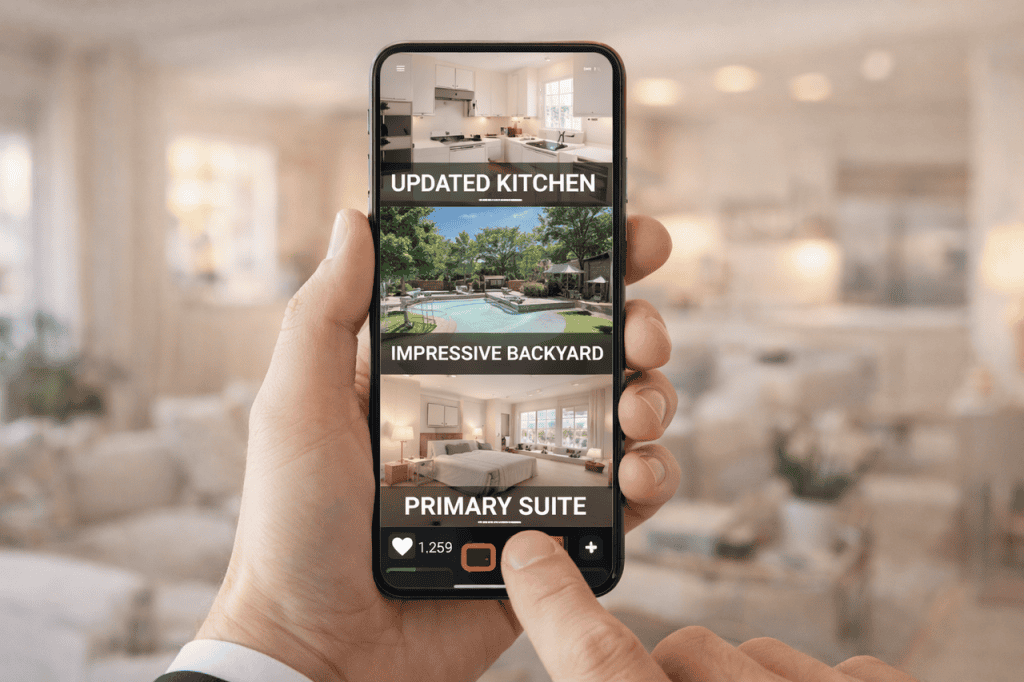
10–20s “feature spotlight” (kitchen, view, yard, primary suite)
Where ListingHub.ai fits: paste a listing link (or upload photos) to generate videos quickly via ListingHub’s AI Real Estate Video Generator.
Trend 4: Captions + voiceover become standard (accessibility + retention)
Silent viewing is normal in short-form. Captions also help viewers understand a property faster—especially when the video pacing is quick.
What to do now:
- Always publish with captions
- Keep voiceover hyper-specific to the home (avoid generic “luxury vibes” filler)
- If you use AI voice, review for accuracy (beds/baths, upgrades, location claims)
Where ListingHub.ai fits: ListingHub includes AI voiceover and auto captions/subtitles, so every video is ready for silent viewing and faster comprehension.
Trend 5: AI avatars (digital humans) enter real estate—but trust rules the rollout
AI presenters can raise consistency and output. But overuse (or uncanny presentation) can reduce trust—especially in an industry where credibility is the product.
What to do now: use avatars strategically:
- Market updates (60–90s)
- Quick listing intros (5–10s)
- Multilingual variants (only with careful review)
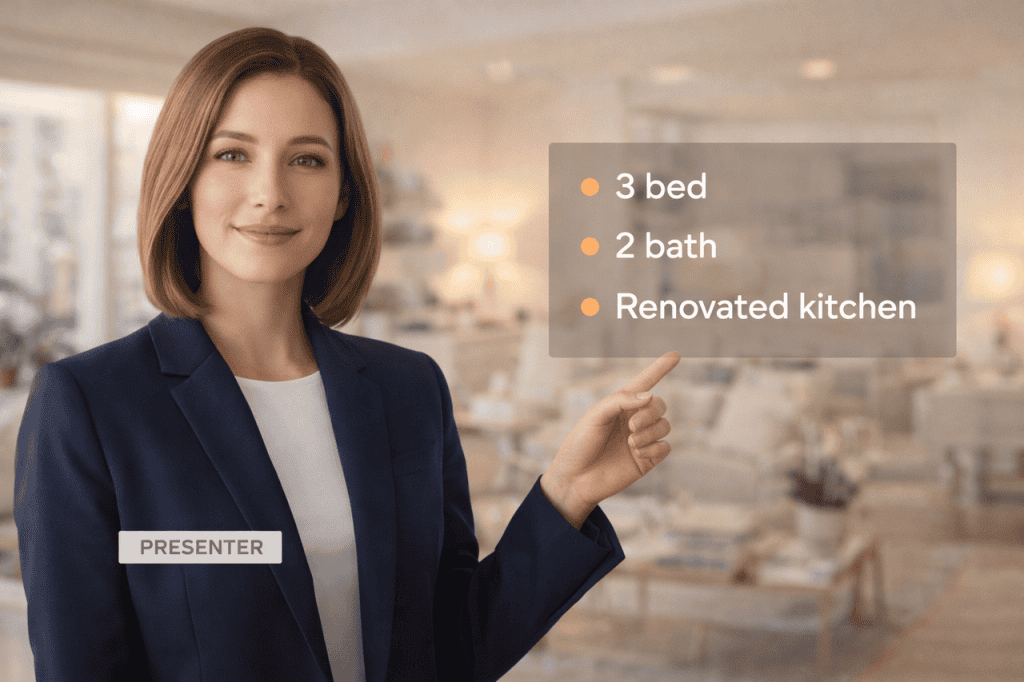
Where ListingHub.ai fits: ListingHub supports digital human narration (avatar presenter) so you can appear “on camera” without recording every time. Tip: keep the script factual and local; avoid exaggerated claims.
Trend 6: “Interactive” experiences set buyer expectations (even when your videos are linear)
Even if your short-form videos can’t branch, buyer expectations are being shaped by richer listing experiences. Zillow notes Showcase listings are driving 79% more page views, 76% more saves, and 91% more shares than similar non-Showcase listings on Zillow (based on Zillow’s analysis and methodology disclosures).
What to do now: simulate “choose your path” in short-form:
- Use a pinned comment: “Comment ‘KITCHEN’ and I’ll DM the kitchen tour”
- Publish a 3-part sequence: Exterior → Kitchen/Living → Primary suite/Backyard
- Add clear chapter-style overlays: “Stop 1: Kitchen” / “Stop 2: Primary Suite”
Where ListingHub.ai fits: generate multiple short clips per listing (feature spotlights) so buyers can self-qualify faster.
Trend 7: Real-time + livestream comes back (because AI fatigue is real)
As AI content becomes more common, real-time video becomes a trust multiplier. Even a simple weekly live walk-through can outperform polished-but-generic edits.
What to do now: run one weekly live format:
- “New listings this week in [Neighborhood]”
- “Open house walk-through (live Q&A)”
- “Ask me anything: buying in 2026”
Then clip the best moments into Shorts/Reels.
Where ListingHub.ai fits: use ListingHub for the repeatable “baseline” assets (listing highlight reels, teasers), and pair them with your occasional live content for authenticity.
Trend 8: “Local proof” beats “global polish”
The most defensible content in 2026 is what a generic competitor can’t copy:
- Parking reality
- School pickup traffic
- Seasonal light in the living room
- Street noise at rush hour
- Flood risk context (where applicable, stated carefully)
What to do now: build a “local proof checklist” for your farm area and rotate through it weekly.
Where ListingHub.ai fits: combine your local proof footage with ListingHub-generated listing clips so your content mix stays consistent even when you’re not filming daily.
Trend 9: AI staging + AI edits must be disclosed (or it backfires)
AI enhancements can help presentation, but misleading visuals damage credibility. NAR’s 2025 Profile of Home Staging reports buyers’ agents say having videos (48%) and virtual tours (43%) available is “much more” or “more” important to clients—so visuals matter, but trust matters more.
What to do now:
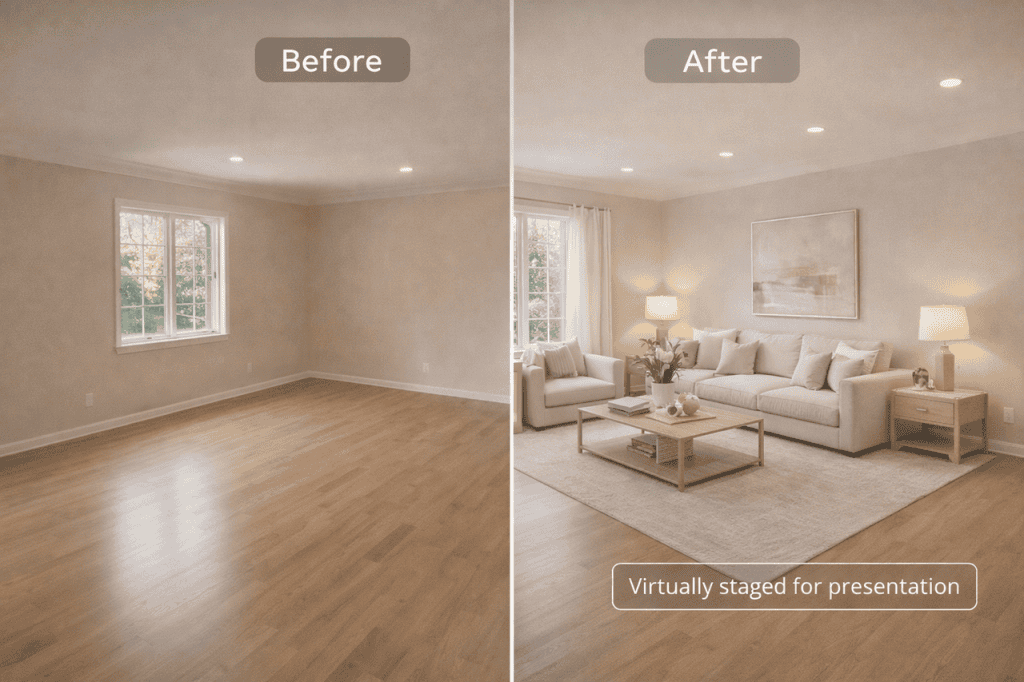
- Add a consistent disclosure line in descriptions: “Some visuals may be virtually staged or AI-enhanced for presentation.”
- Keep originals archived
- Avoid altering permanent features (views, windows, layout, lot lines)
Where ListingHub.ai fits: ListingHub provides photo enhancement and staging capabilities via AI Real Estate Photo Enhancement Tools—use them to clarify presentation, and disclose when relevant.
Trend 10: Distribution becomes portfolio-first (not platform-first)
In 2026, you want a portfolio that compounds:
- Short-form (Reels/TikTok/Shorts) for reach
- YouTube (longer shelf life + search behavior)
- Website/blog embeds (SEO + conversion)
- Email (nurture + seller proof)
What to do now: plan every video with 2–3 destinations:
- Vertical short for reach
- Horizontal version for YouTube/blog embed
- Still frames for carousel posts
Where ListingHub.ai fits: generate both aspect ratios and reuse your scripts/captions across channels. Pair with AI Listing Description Writer to keep copy consistent across MLS, social, and email.
Trend 11: “Seller-proof” reporting matters more (performance transparency becomes a differentiator)
Sellers want evidence—not promises. Platforms are increasingly surfacing performance metrics to support listing conversations.
What to do now: build a simple seller reporting pattern:
- Weekly: views, saves, shares, showing activity (where available)
- Video engagement: 3-second holds, average watch time, comments
Where ListingHub.ai fits: package video + copy + visuals consistently so you can run clean A/B comparisons between listings and iterate faster.
Trend 12: The winning workflow is “fast draft → human polish → publish”
AI speeds production, but humans protect accuracy, context, and trust.
What to do now: set a non-negotiable QA checklist before posting:
- Facts correct (price, beds/baths, HOA, key upgrades)
- No prohibited/biased language
- Disclosures included where needed
- Location claims are precise and defensible
Where ListingHub.ai fits: ListingHub handles the heavy lifting (draft video + captions + scripts), while you add the neighborhood nuance and final compliance review.
Your Weekly “Video Operating System” for 2026 (simple + repeatable)
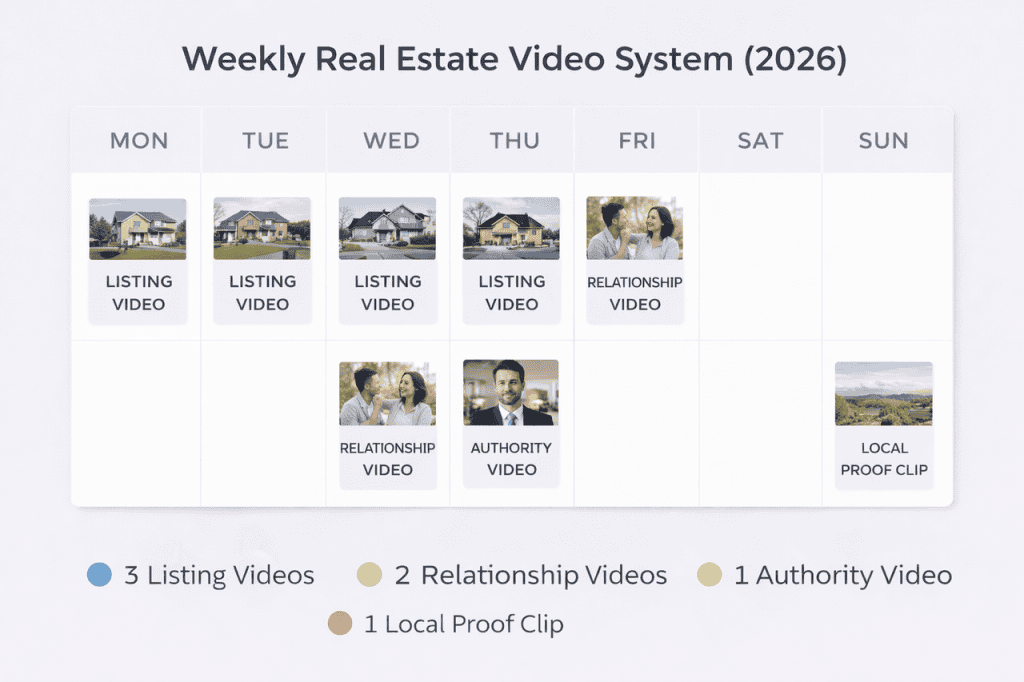
3 listing videos/week
- 1 highlight reel (30–60s)
- 1 feature spotlight (10–20s)
- 1 update clip (price change, open house, “why this home”)
2 relationship videos/week
- 1 video reply to a lead question
- 1 “3 options for you” shortlist walkthrough
1 authority video/week
- 60–90s market update (inventory, seasonality, neighborhood trends)
Why this works: it balances speed (AI + templates) with trust (human context + personalization).
FAQ
1. What matters most in real estate video marketing in 2026?
Trust-driven clarity. Buyers want visuals (virtual tours and videos rank “very useful” in NAR’s buyer research) and they want the information to feel accurate and local.
2. Should real estate agents prioritize virtual tours or listing videos?
Do both when possible. In NAR’s Generational Trends report, buyers rate virtual tours (41%) and videos (29%) as “very useful” website features among online home shoppers—meaning each serves a different buyer intent stage.
3. Are AI-generated listing videos good enough for 2026?
They’re excellent for speed and consistency—especially when you add a human accuracy pass. The best workflow is fast AI draft → human polish → publish.
4. Do I need captions on real estate videos?
Yes. Captions improve comprehension for silent viewers and reduce drop-off—especially on short-form platforms.
5. How do I turn one listing into multiple videos quickly?
Use a photo-to-video workflow and produce:
- Highlight reel
- Teaser hook
- Feature spotlight clips ListingHub is designed for this style of batch output: https://www.listinghub.ai/real-estate-video
6. What’s a safe disclosure line for AI staging or enhancements?
A simple, buyer-friendly option: “Some visuals may be virtually staged or AI-enhanced for presentation.” Also keep originals archived.
