
2026 Real Estate Video Marketing Guide: A Realtor’s Real Experience
Hey there, I’m Mike. I’ve been a real estate agent in the Greater Vancouver area for 12 years, and I’ve witnessed the industry’s complete transformation from newspaper ads to social media marketing. Today, I want to share some real-world insights about video marketing.
Last year, my team closed 87 properties, and a significant portion of those first client contacts came through social media videos. This made me realize: video content has become a critical component of real estate marketing in 2026.
But here’s the reality—I’ve seen many colleagues invest thousands in equipment and video editing courses, only to give up because the workflow was too complicated. The issue often isn’t effort; it’s whether the tools and methods actually fit our day-to-day real estate work.

Contents
- 1 I. Why Traditional Video Editing Software Falls Short for Real Estate Work
- 2 II. Key Observations About Real Estate Video Marketing
- 3 III. Finding the Right Tools for Real Estate Work
- 4 IV. Practical Application Scenarios
- 5 V. Points to Consider When Using
- 6 VI. Thinking About Tool Investment
- 7 VII. Recommendations for Agents at Different Stages
- 8 VIII. Some Observations on 2026 Video Marketing
- 9 IX. Summary
I. Why Traditional Video Editing Software Falls Short for Real Estate Work
The Gap Between Professional Tools and Real Needs
To be honest, back in 2019 I did invest in professional video editing software and spent time learning the basics. But after a few months, I discovered a clear mismatch between these tools’ design philosophy and the actual demands of real estate work.
The Reality of Time Costs
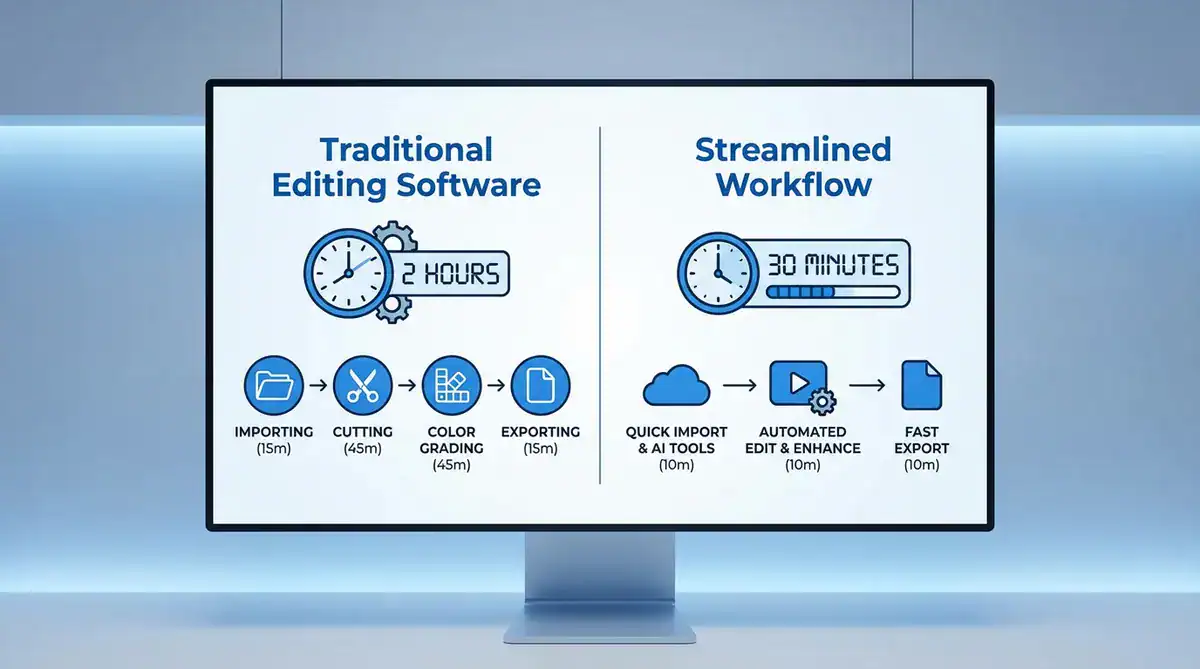
Creating a 2-minute property video with professional editing software actually requires:
- Importing and organizing footage: 15-20 minutes
- Cutting and adjusting: 40-60 minutes
- Adding text and music: 15-30 minutes
- Exporting and checking: 15-20 minutes
- Total: approximately 1.5-2 hours
And that’s not counting the time spent learning the software features. In real estate work, quick content publishing is often more important than technical perfection.
The Learning Curve Challenge
Professional editing software is indeed powerful, but for non-specialists:
- Multi-track timelines
- Color adjustment tools
- Keyframe animation
- Audio processing
These features require considerable learning time to master. And as real estate agents, our core job is serving clients and understanding the market—not becoming video tech experts.
The Limitations of Mobile Quick-Edit Tools
Another option is using video editing apps on your phone, like some popular social media built-in editing features.
These tools are certainly convenient, but they have obvious limitations:
Missing Industry-Specific Features
General editing apps are mainly designed for personal users and content creators, lacking the professional needs of real estate:
- Property information display templates
- Quick data insertion features
- Brand consistency management
- Professional disclaimer templates
Last year, I made a video with a phone app that turned out pretty well, but I forgot to add my contact information. While it got decent views, it didn’t convert to actual inquiries.
Output Quality Limitations
Some free apps compress videos significantly to reduce operating costs, affecting final image quality. For showcasing property details, clarity is still quite important.
II. Key Observations About Real Estate Video Marketing
Observation 1: The Importance of Vertical Video Format
This is a trend worth noting: according to Instagram’s public data, the proportion of video views on mobile devices continues to grow, with vertical viewing showing significant increases.
Real Performance of Different Formats
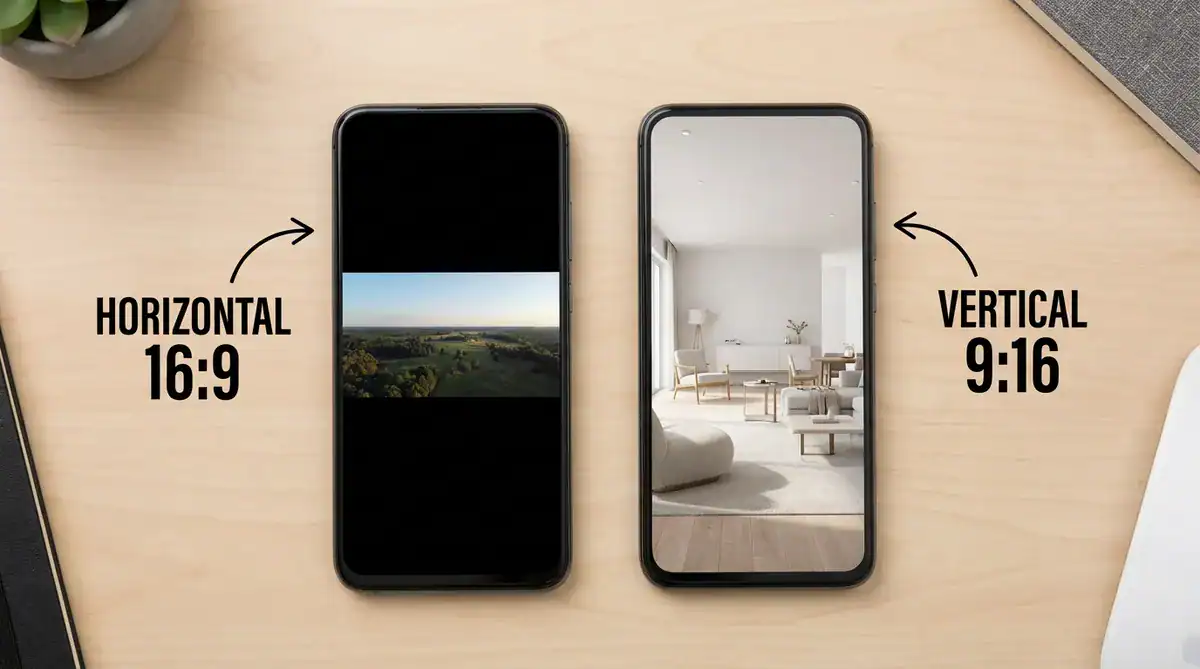
I did a comparison test with the same property posted in two versions:
- Horizontal (16:9): average viewing time about 10 seconds
- Vertical (9:16): average viewing time about 20 seconds
The vertical version had noticeably better engagement, mainly because it takes up more screen space on phones, creating stronger visual impact.
Advantages of Native Vertical Shooting
Simply cropping horizontal video has some issues:
- Content on both sides gets cut off
- Composition center may shift
- Sometimes loses image detail
A better approach is to consider vertical composition when shooting, or use tools that support smart reframing to adjust focal points.
Observation 2: The Value of Publishing Speed
The Importance of Timeliness
In real estate marketing, content freshness matters. Ideally:
Publishing related videos on the same day as an Open House or showing can better capture immediate interest.
This isn’t about sacrificing quality—it’s finding the balance between “good enough” and “fast enough.”
How My Workflow Evolved
Before: Shoot → Go back to office → Spend 1-2 hours editing → Post next day
Now: Shoot → Quick 15-30 minute edit in car or on-site → Post same day
This adjustment makes content more timely and shows potential clients my efficiency.
Observation 3: The Practical Value of AI-Assisted Tools
Over the past two years, AI tools in video editing have matured significantly. From practical experience, several features are genuinely helpful:
Automatic Caption Generation
Many social media videos are watched on mute. Auto-caption features can:
- Quickly generate accurate text
- Recognize common real estate terminology
- Save manual input time
I use this feature on almost every video.
Content Assistance Features
Some new AI features are emerging, such as:
- Automatically identifying and flagging stable/blurry footage
- Basic scene classification (kitchen, living room, bedroom, etc.)
- Simple image enhancement
These features are still developing but can already improve work efficiency to some extent.

III. Finding the Right Tools for Real Estate Work
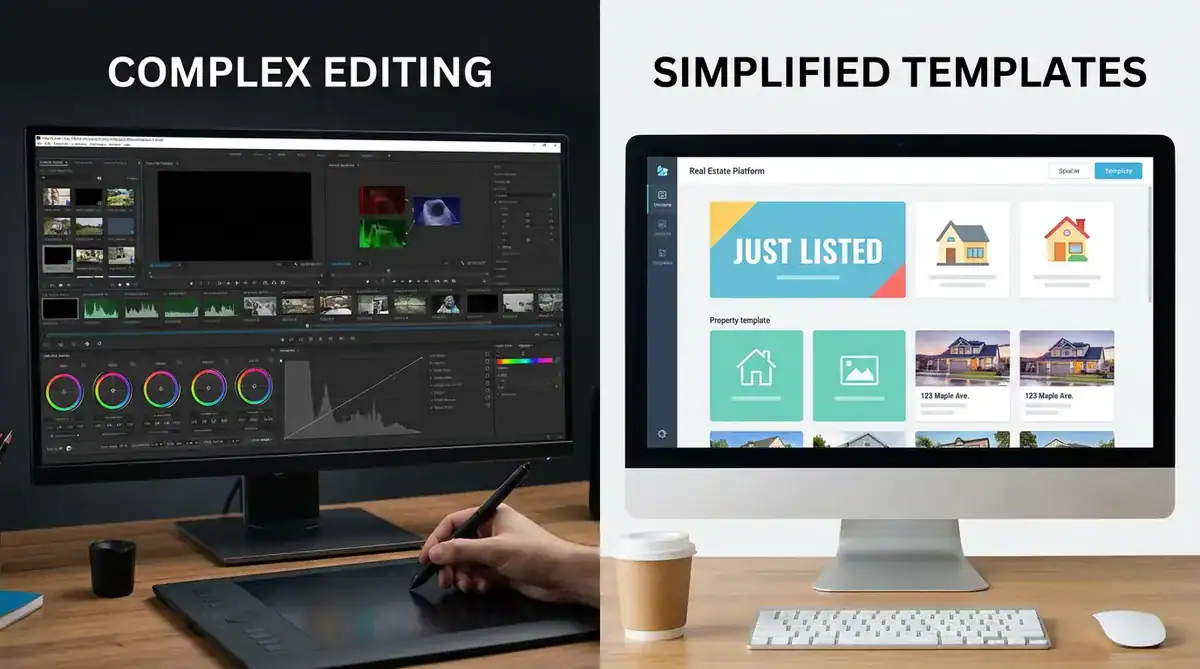
After some trial and error, I started trying platforms specifically designed for the real estate industry. These types of tools have a noticeably different design philosophy from general editors.
Characteristics of Real Estate-Specific Platforms
Compared to general video editors, specialized real estate marketing platforms typically offer:
- Pre-set property showcase templates
- More streamlined operational workflows
- Industry-relevant asset libraries
- Brand management features
These features are quite practical for agents who need to produce content quickly.
My Tool Selection Experience
After trying several platforms, I currently primarily use ListingHub for most video content. Main reasons for choosing it:
Simplified Workflow Compared to professional editing software, creating a basic listing video does save considerable time. From importing footage to completing basic editing usually takes 15-20 minutes.
Property Information Integration It’s relatively convenient to add basic property information (price, square footage, etc.) to videos without creating separate graphics.
Template Resources The platform provides some commonly used video templates, like “Just Listed,” “Open House,” etc., that can be applied directly, saving design time.
Of course, these tools aren’t a cure-all and still require adjustment and optimization based on specific projects. But for daily listing video production, the efficiency improvement is quite noticeable.
Some Insights from Using It
Templates Are Just a Starting Point
While templates are convenient, relying entirely on them makes content look cookie-cutter. My approach:
- Use templates to complete the basic framework
- Adjust details based on property characteristics
- Add some personalized elements
Maintain Brand Consistency
The platform has asset management features to save commonly used logos, color schemes, etc. This way, brand elements can be quickly applied each time you make a video, maintaining visual unity.
Adjust Format for Different Platforms
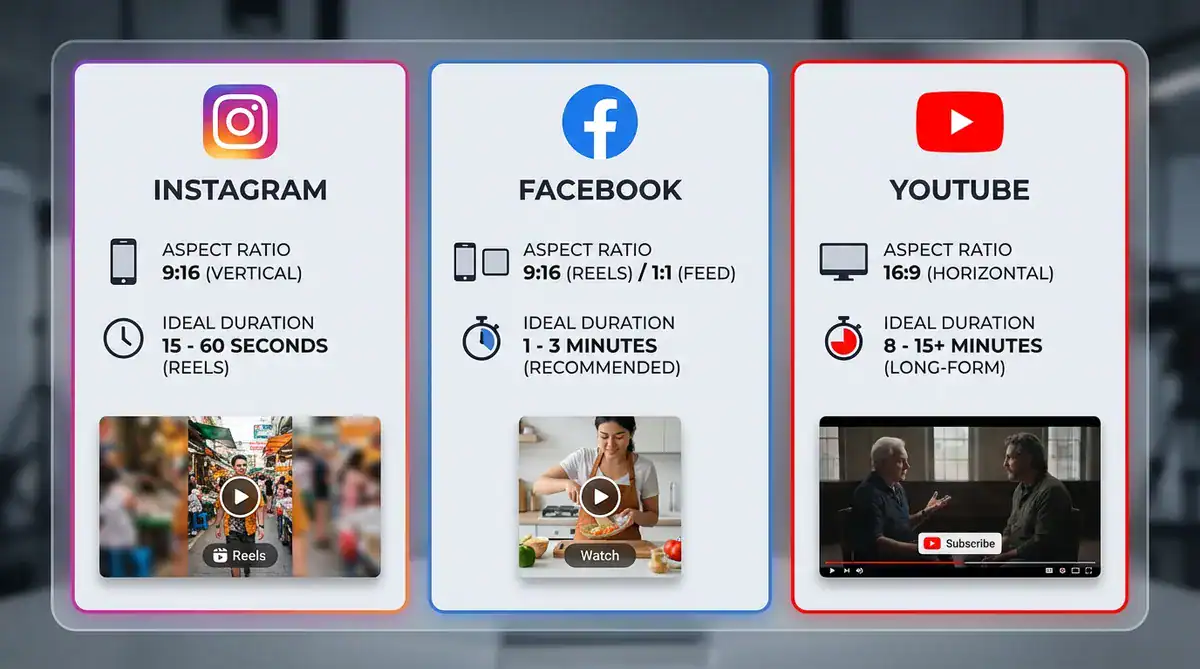
Different social media platforms have different video format requirements. When creating, consider:
- Instagram Reels: Vertical, 30-60 seconds works well
- Facebook: Horizontal or vertical both work
- YouTube Shorts: Vertical, under 60 seconds
IV. Practical Application Scenarios
Let me share a few typical use cases to see how these tools fit into daily work.
Scenario 1: Pre-Open House Promotion
Background: Sunday afternoon Open House, want to build anticipation on social media beforehand.
Process:
- Saturday morning, shoot 10-15 minute walkthrough at property
- Back in car or office, import footage
- Select “Open House” template, quickly edit into 45-second clip
- Add time and location information
- Post Saturday afternoon
Result: Gets more potential buyers aware of the event, usually increases attendance by a few groups.
Scenario 2: Instant New Listing Share
Background: Just got a new listing, want to get the word out quickly.
Process:
- Record brief introduction on-site (30-60 seconds)
- Use mobile app for basic editing
- Add “Just Listed” tag and basic information
- Post same day to Instagram and Facebook
Time: About 20-30 minutes from shoot to publish
This quick publishing can capture first-moment attention, which has more timely value than waiting days to make a polished video.
Scenario 3: Market Analysis Content
Background: Want to build professional image by regularly sharing market insights.
Process:
- Choose a topic (like “Recent sales trends in a certain area”)
- Prepare simple talking pointsRecord 2-3 minute explanation
- Add some relevant data charts
- Schedule for appropriate time
Frequency: I typically do this type of content every two weeks
This type of content isn’t for immediate client acquisition, but for long-term professional image building.
V. Points to Consider When Using
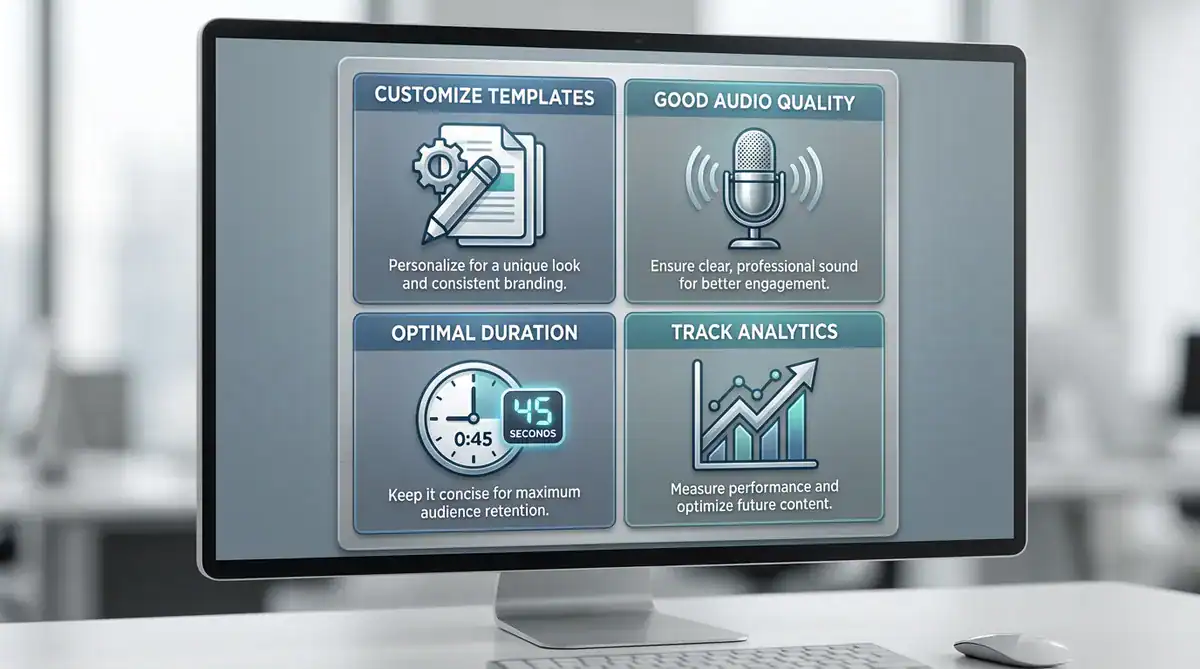
Point 1: Template Usage Boundaries
Lesson Learned:
When first getting familiar with these tools, because templates are so convenient, it’s easy to over-rely on them, making all videos look too similar.
Recommended Approach:
- Templates complete 80% of basic work
- Reserve 20% space for personalization
- Adjust colors and style based on property characteristics
For example, waterfront properties might suit blue tones better, while mountain view homes might work better with green tones. These detail adjustments make content more targeted.
Point 2: The Importance of Audio Quality
Lesson Learned:
For a while, I focused too much on visuals and neglected audio. Got viewer feedback that background noise affected viewing experience.
Recommended Approach:
- Avoid recording in windy or noisy environments
- Consider using simple external microphones (not expensive)
- Use noise reduction features in post-production to clean up audio
- Pay attention to volume balance when adding background music
Good audio quality can significantly boost overall professionalism.
Point 3: Content Duration Control
Lesson Learned:
Initially thought longer content was more comprehensive, made many 3-5 minute detailed videos. But data showed many viewers stopped watching around 30 seconds.
Recommended Approach:
Adjust duration based on platform characteristics:
- Instagram Reels: 30-60 seconds works well
- Facebook: 60-90 seconds
- YouTube detailed version: Can be 3-5 minutes
Use short videos for social media to quickly attract attention, upload longer videos to YouTube for in-depth understanding. Combining both works better.
Point 4: The Value of Data Tracking
Lesson Learned:
Used to just post videos and move on, never looked at data feedback.
Recommended Approach:
Regularly check:
- View counts and completion rates
- Which content types perform better
- Best posting times
- Audience engagement
Optimize subsequent content strategy based on this data. For example, I found market analysis videos perform better Monday mornings, so I adjust posting times accordingly.
VI. Thinking About Tool Investment
Choosing the right tools is an investment decision that requires weighing costs and benefits.
Time Cost Considerations
For real estate agents, time is often more valuable than direct monetary costs.
Taking listing video creation as an example:
- Professional editing software: May take 1-2 hours
- Real estate-specific platform: Usually shortened to 20-30 minutes
This saved time can be used for:
- Following up with more potential clients
- Attending networking events
- Learning market knowledge
- Maintaining work-life balance
Outsourcing vs. DIY
Outsourcing Considerations:
- Pros: Professional quality, don’t need to spend time learning
- Cons: Higher cost, longer turnaround time, can’t publish instantly
DIY Considerations:
- Pros: Quick response, controllable cost, can adjust on the fly
- Cons: Requires learning time, initial quality may not be as professional
My approach is a hybrid model:
- Consider outsourcing or spending more time on important listing videos
- Handle daily social media content myself quickly
Standards for Choosing Tools
Based on practical experience, I think these factors should be considered when choosing tools:
- Learning Curve: Can you get up to speed quickly
- Workflow: Does it fit the actual rhythm of real estate work
- Output Quality: Does it meet basic professional standards
- Cost-Effectiveness: Is the price within a reasonable range
Different agents have different situations and need to choose based on their actual needs.
VII. Recommendations for Agents at Different Stages
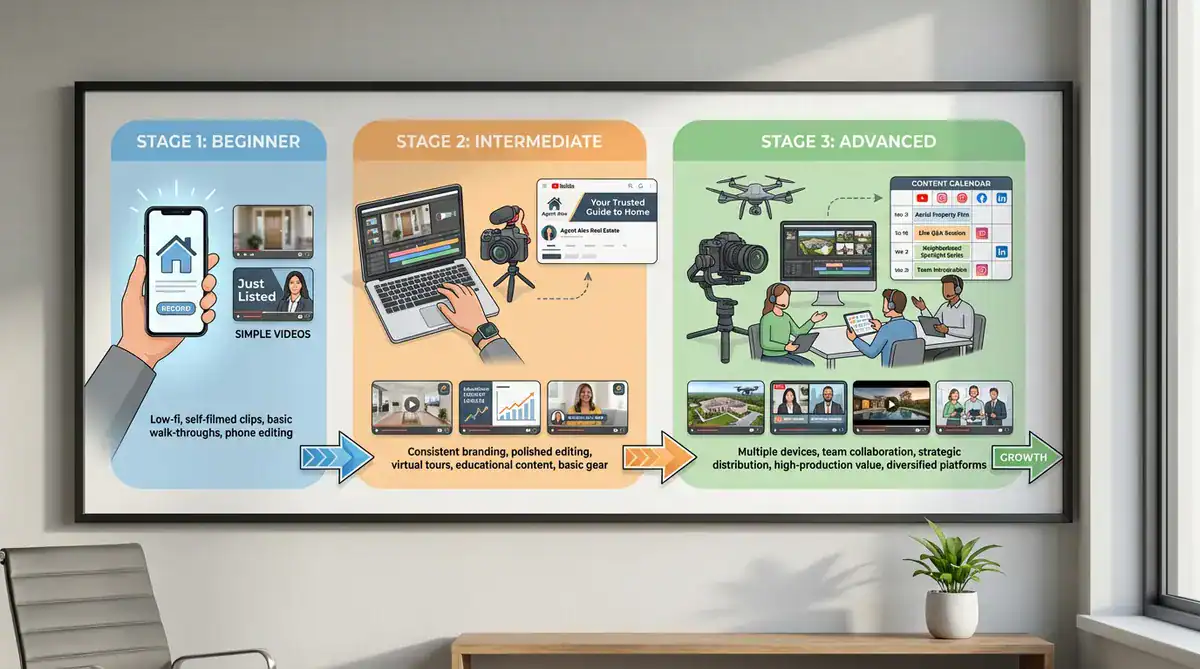
If You’re Just Starting Out
Your Advantage: Can directly adopt new working methods without changing old habits.
Recommendations:
- Start with Simple Equipment
- Modern smartphone video quality is sufficient
- No need to invest in expensive professional equipment right away
- Prioritize Content Frequency
- Regular posting is more effective than occasional masterpieces
- Building presence requires consistent content output
- Use Templates to Build Consistency
- Choose fixed colors and style
- Let viewers gradually become familiar with your visual style
If You Have Several Years of Experience
Your Challenge: May already have established work methods that need adjustment.
Recommendations:
- Gradual Change
- Don’t need to completely overhaul immediately
- Can start with social media short videos
- Gradually expand to other content types
- Leverage Existing Client Resources
- Past closed clients are great content material
- Client testimonials and follow-up content are worth recording
- Build Content Planning
- Create a simple content calendar
- Balance listing content with market analysis content
If You Lead a Team
Your Opportunity: Can systematically improve entire team efficiency.
Recommendations:
- Unified Brand Management
- Ensure team members use consistent brand elements
- Build shared asset library
- Content Division of Labor
- Recording can be done by agents
- Editing and publishing can be assisted by staff
- Clarify responsibilities for each step
- Regular Experience Sharing
- Share effective content strategies within team
- Analyze what types of content perform better
VIII. Some Observations on 2026 Video Marketing
Based on recent industry trends, several trends are worth noting:
Trend 1: The Value of Authentic Content
Observed Changes:
Audiences are developing fatigue toward overly polished content. In contrast, more authentic, natural content is getting better responses.
For example:
- Agents’ on-site instant shares
- Real market observations and commentary
- Not overly polished walkthroughs
Strategy Adjustment Suggestions:
- Maintain professionalism in most content
- Appropriately include some more spontaneous content
- Let viewers see the real you
Trend 2: Short Video Continues to Dominate
The popularity of short video platforms isn’t temporary—it’s an ongoing change in content consumption habits.
The key is:
- Adapt to different platform characteristics
- Learn to deliver key information quickly
- Maintain content appeal
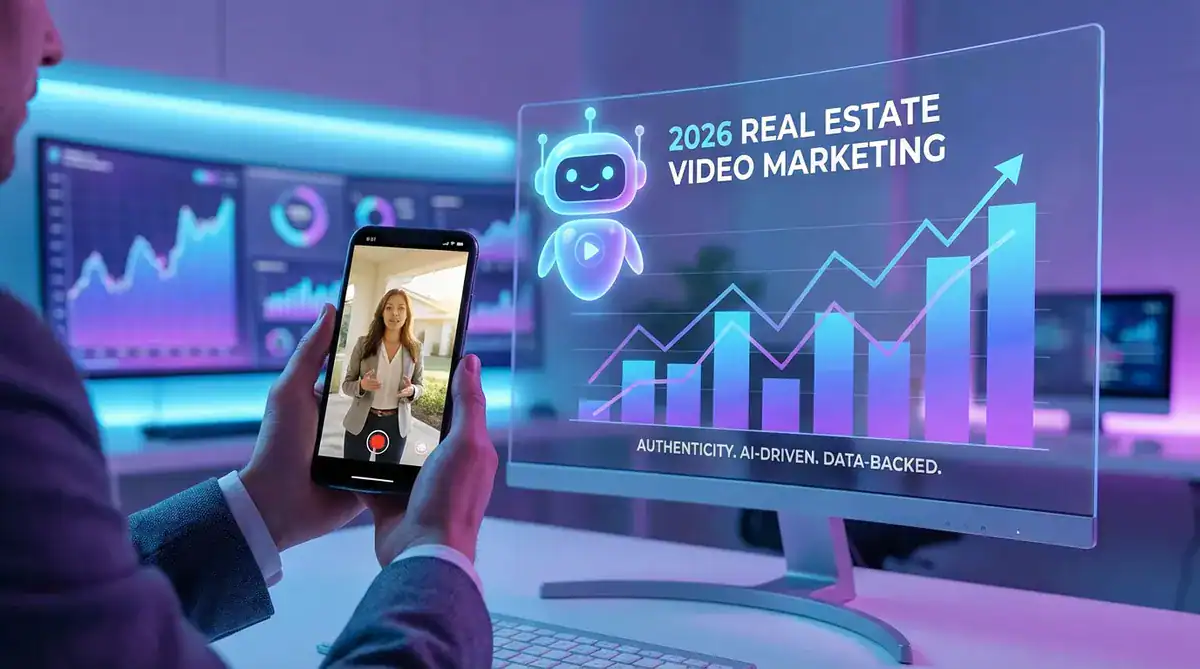
Trend 3: Development of Tech-Assisted Tools
AI and automation tools will continue to evolve, but their role is to assist rather than replace:
- Handle repetitive work
- Improve basic efficiency
- Give agents more time to focus on interpersonal interaction
The key is: Finding the balance between technology and human touch.
IX. Summary
The importance of video content in real estate marketing continues to grow. But the key isn’t using the latest technology or most expensive equipment—it’s finding methods that fit your workflow.
Core Principles
Reviewing these experiences, several points are particularly important:
1. Action is More Important Than Perfection
Don’t wait for perfect conditions to start. Use available equipment and tools to begin, and continuously improve through practice.
2. Tools Should Serve Work, Not Add Burden
Choose tools that improve efficiency rather than increase learning burden. Your core job is serving clients, not becoming a video tech expert.
3. Authenticity is More Valuable Than Flash
Audiences can sense content authenticity. Rather than spending excessive time pursuing technical perfection, maintain sincerity and professionalism in content.
4. Consistency is More Important Than Viral Hits
The long-term value built by regular content posting far exceeds occasional viral videos.
Take Action
If you haven’t started systematically creating video content, now is a good time:
- Start with simple content (property introductions, market observations)
- Choose tools and platforms that suit you
- Set a sustainable posting frequency
- Continuously optimize based on data feedback
Video marketing isn’t an “all or nothing” decision—it’s a process you can advance gradually.
Final Thoughts
This article shares my personal experience and observations. Different markets and individual situations will vary. The key is finding your own rhythm and methods.
If you’re already creating video content, I hope these experiences provide some reference. If you’re still hesitating, why not start with the simplest thing—use your phone to shoot a 30-second property introduction and experience the whole process.
The market is changing, tools are evolving, but the core remains: Sincerely provide value to clients and deliver information in the most effective way.
