
Essential Professional Competencies for Real Estate Leaders in the Age of AI
Let me be straight with you – I’ve been in real estate for over a decade, and I’ve watched countless “game-changing” technologies come and go. But AI? This one’s different. It’s not about whether you’ll use it; it’s about how quickly you’ll figure out what actually works.
I’m not here to sell you on some futuristic vision. I’m here to share what I’ve learned the hard way: which skills actually matter when you’re trying to run a brokerage or team in 2026, and how to cut through the noise when everyone’s shouting about their AI solution.

Contents
The Four Competencies That Actually Matter
Strategic Vision: Avoiding the Tool Trap
Here’s what I see happening: A broker attends a conference, gets excited about some AI demo, signs up for the platform, and six months later, nobody’s using it. Sound familiar?
The issue isn’t the technology. It’s that we’re buying solutions before we understand the problem. I learned this after wasting money on three different “revolutionary” CRM systems that my team ignored because they didn’t actually solve a pain point.
Real strategic vision means starting with your business objectives. Are you trying to help agents close more deals? Reduce the time they spend on admin work? Improve listing presentation quality? Once you know that, then you look for tools – not the other way around.
Understanding Your Data Situation
I’m going to say something that might sound boring: your data is probably a mess. Mine was too.
We had client information scattered across emails, spreadsheets, our CRM, and random sticky notes. When I finally sat down to look at it, I found duplicate entries, incomplete phone numbers, and addresses that were just flat-out wrong. You can’t run AI on garbage data and expect gold to come out.

What Data Governance Really Means
You don’t need to become a data scientist. But you do need to care about how information gets entered into your systems. I started with something simple: a one-page guide for my team showing exactly how to input new client information. Same format every time. No exceptions.
It felt tedious at first. Agents complained. But three months later, when we wanted to analyze which neighborhoods were hottest for repeat clients, we actually could. The data was there, clean and usable.
Leading People Through Change
This is the hard part. Technology is easy compared to managing the human reaction to it.
When I first mentioned using AI tools to my team, one of my top producers said, “So you’re trying to replace us?” That stung, but it taught me something important: fear is the default response.

Reframing the Conversation
I stopped talking about “AI adoption” and started talking about “getting your time back.” That resonated. Everyone in this business feels overwhelmed. If you can genuinely show how a tool saves them two hours a week, they’ll pay attention.
One of my agents was spending entire evenings writing listing descriptions. She’d agonize over every word. I showed her how she could use AI to draft the first version in minutes, then spend her time refining it and making it personal. That was her “aha” moment. She wasn’t being replaced – she was being freed up to do the parts of the job she actually enjoyed.
Making Smart Technology Choices
The real estate tech landscape is crowded. Every week there’s a new platform promising to revolutionize everything. Most of them don’t.
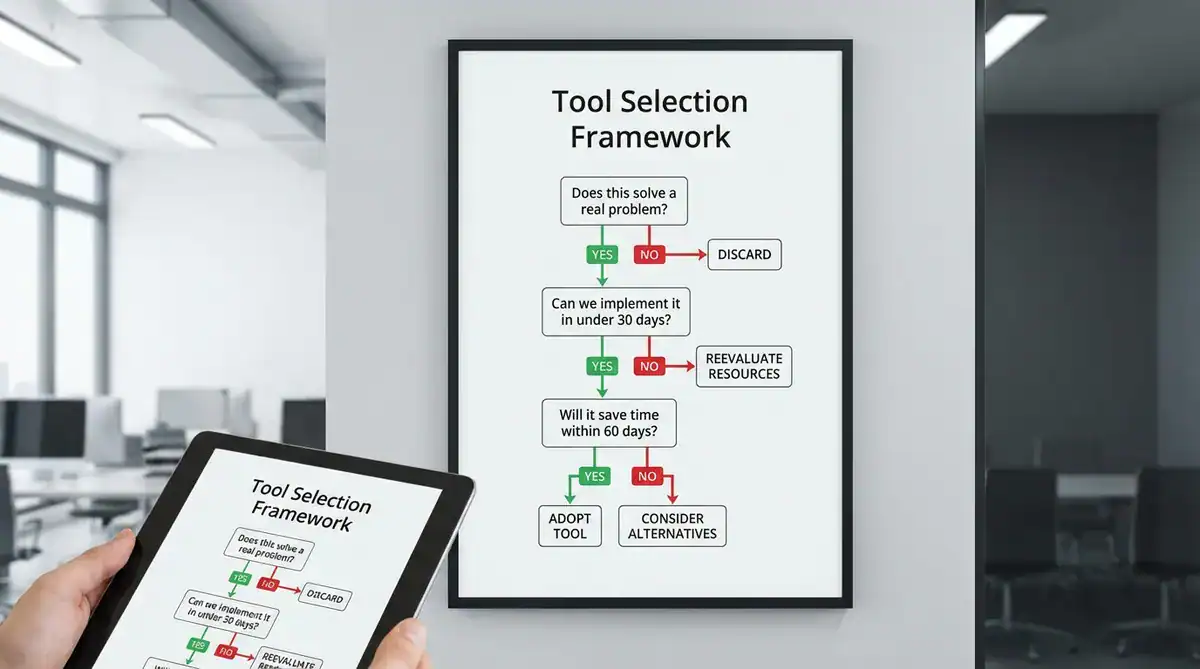
Here’s my framework: I only consider tools that solve a specific, painful problem that my team actually has. Not problems I think they should have or problems that sound impressive in a meeting. Real, daily frustrations.
Where AI Actually Works Right Now
Marketing and content creation are the most mature applications. This isn’t controversial – it’s just reality. Creating listing videos, writing property descriptions, editing photos, generating social media content – these tasks take hours and they’re somewhat formulaic. That makes them perfect for automation.
I’ll give you a real example. We used to spend about three hours per listing on marketing materials. Photos needed editing, descriptions needed writing, social posts needed creating, and someone had to put together a decent-looking flyer. Now? We can handle the bulk of that in under 30 minutes using specialized tools, and the agent just reviews and personalizes the output.
That doesn’t mean the tools are perfect. They’re not. But they’re good enough to get you 80% of the way there, which is what matters when you’re trying to list 30 properties a quarter.
The Real Implementation Process
Start with One Problem
I see brokers trying to transform their entire operation overnight. It never works. Change management 101 says to start small and build momentum.
Pick the single most annoying bottleneck in your current workflow. For us, it was listing marketing. Agents dreaded it, it took forever, and honestly, the quality was inconsistent. So that’s where we started.

The 30-60-90 Day Approach
First 30 days: Pick one tool for one specific task. Get three agents to test it. That’s it. Don’t roll it out company-wide. Just learn what actually works in real-world conditions.
Days 31-60: Based on what you learned, refine the process. Create a simple guide – I’m talking one page, with screenshots. Train the early adopters to help their peers.
Days 61-90: Broader rollout, but still with support. Have weekly office hours where people can ask questions. Track actual time savings, not hypothetical ones.
Building Team Buy-In
The agents who adopt new tools fastest aren’t necessarily the youngest or most tech-savvy. They’re the ones who see their peers having success.
I started hosting monthly “tool time” sessions – 30 minutes where agents share one thing they’ve automated or improved. No pressure, no judgment. Just peer-to-peer learning. That created more momentum than any mandate from me ever could.

Maintaining the Human Element
The Ethics Question Nobody Talks About
Here’s something that keeps me up at night: AI can encode biases. If you train a model on historical data that reflects past discrimination, it’ll perpetuate those patterns.
I’m not saying this to scare you. I’m saying it because we have a responsibility. Fair Housing isn’t just about what we say directly to clients – it’s about what our algorithms recommend, how they price properties, and which listings they suggest.
Practical Oversight
Every AI-generated output in my brokerage gets human review before it goes public. Every property description, every valuation, every marketing email. It’s non-negotiable.
Is this extra work? A little. But it’s necessary. And honestly, most of the time, the AI gets it 95% right. We’re just checking for that 5% where it might suggest something inappropriate or miss an important nuance.

What Clients Actually Want
I’ve had this conversation with dozens of buyers and sellers. You know what they tell me? They don’t care that I use AI. What they care about is responsiveness, expertise, and feeling heard.
The technology helps me be more responsive because I’m not drowning in administrative tasks. It helps me be more expert because I can quickly pull comparable data and market trends. But it doesn’t replace the conversation where I listen to why they’re selling and what they’re worried about.
That’s the part that still requires a human. And probably always will.
What I Wish I’d Known Earlier
The Budget Question
You don’t need a massive budget. I started with about $200 a month in tool subscriptions. That covered the essentials. As we saw ROI, we added more. But you don’t need enterprise-level platforms to see benefits.
Smaller teams actually have an advantage here. We can test things quickly, pivot fast, and don’t have layers of approval slowing us down.
The Learning Curve Is Real
Nothing works perfectly out of the box. Every tool has a learning curve. Budget time for that. When I say a tool saves three hours per listing, I’m talking about after you’ve used it 10-15 times and figured out the quirks.
The first few tries? They’ll probably take longer than your old method. That’s normal. Don’t give up after one attempt.

Culture Beats Strategy
I spent months obsessing over which tools to choose. That was important, but you know what mattered more? Creating a culture where it was safe to try new things and admit when something wasn’t working.
Some tools we tested were duds. Some worked great for one agent but not others. That’s fine. The point is that we kept experimenting and learning.
The Real Bottom Line
AI in real estate isn’t about replacing agents. It’s about removing friction. It’s about letting talented people focus on the high-value work – the negotiation, the relationship building, the local expertise – instead of spending hours on tasks that can be automated.
Will some agents refuse to adapt? Probably. Will some tools fail to live up to the hype? Definitely. But the core shift is happening regardless. The question is whether you’re going to be intentional about it or reactive.
I’m not pretending to have all the answers. I’m still figuring this out myself. But I can tell you that the brokers and team leads I respect most are the ones asking good questions, testing carefully, and keeping their focus on what actually moves the needle for their business.
That’s the competency that matters most: the ability to separate signal from noise, to implement thoughtfully rather than desperately, and to remember that all of this technology is just a tool to help us do our jobs better.
The human part? That’s still on us.
FAQ
Will AI eventually replace real estate agents?
No, but the role is evolving. I’ve closed over 300 transactions, and I can tell you that the emotional complexity, negotiation subtlety, and local market intuition required for most deals can’t be automated. What’s changing is that agents who learn to leverage these tools will simply outperform those who don’t.
What’s the best way to introduce AI to a hesitant team?
Start with the work nobody enjoys. Admin tasks, data entry, photo editing – the stuff that keeps agents at their desk when they’d rather be with clients. Once they experience genuine time savings, the conversation shifts from “Will this replace me?” to “What else can this do?”
How much technical knowledge does a leader actually need?
Less than you think. You need enough understanding to ask vendors the right questions and to spot nonsense. Can you explain what the tool does and what its limitations are? Can you assess whether it actually solves your problem? That’s sufficient. You don’t need to understand the algorithms.
Is AI only for large brokerages with big budgets?
Actually, smaller teams often move faster. We implemented our first AI tools with less than 15 agents and a modest budget. The advantage of being small is that you can test, learn, and adjust quickly without corporate bureaucracy slowing you down.
