
Drone Photography for Real Estate Under $500K: A Practical Guide from the Field
After photographing over 200 residential listings in the past three years, I’ve noticed something interesting: it’s not the $2 million estates that benefit most from drone photography—it’s the homes sitting right in the middle of the market. The $300K to $500K range is where aerial shots can genuinely change outcomes, but only when used strategically.
Let me share what I’ve learned about when drone photography actually makes sense for mid-range properties, and more importantly, when it doesn’t.
Contents
Why the Middle Market Needs a Different Approach
The Competition Problem Nobody Talks About
Here’s the reality: if you’re listing a $350,000 three-bedroom colonial, you’re competing with 15 other nearly identical homes within a five-mile radius. The $4 million estate down the road? It might be the only one like it in the entire county.
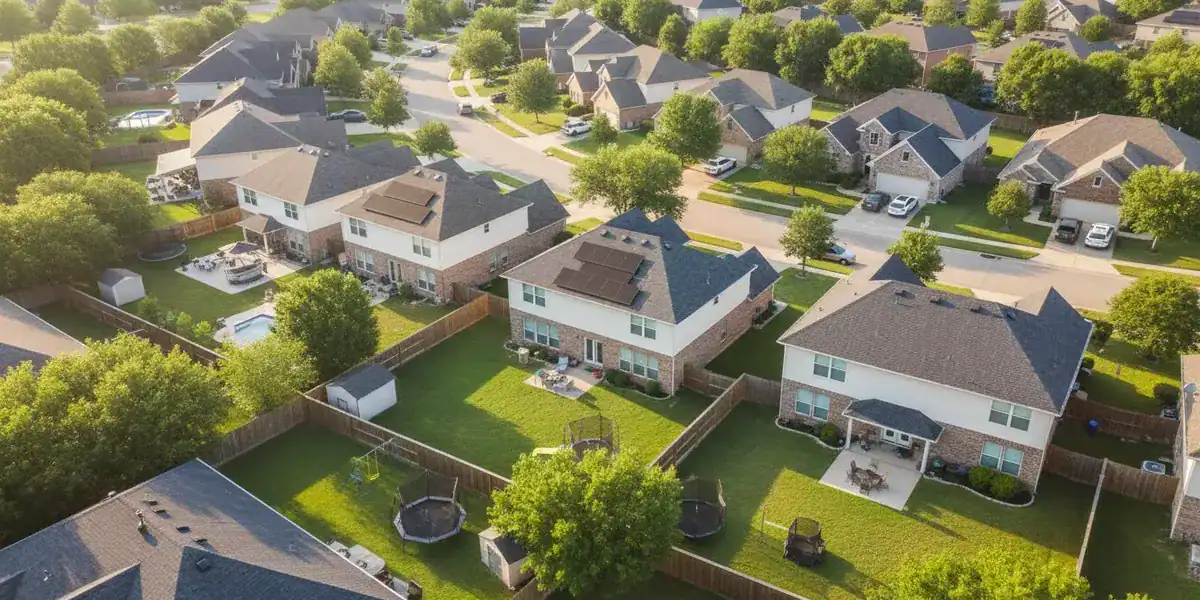
I learned this the hard way with a listing in Maple Grove last year. Standard interior photos, nice curb appeal shot, listed at $425,000. After three weeks and only four showings, we brought in a drone pilot for $175. The aerial photos revealed something the street-level shots couldn’t: the property backed onto protected wetlands with a walking trail, and the lot was nearly twice the size of neighboring homes.
We had an offer within nine days of updating the photos.
The data backs this up. According to MLS analytics, homes with aerial imagery in the $400K-$500K bracket typically sell 20-30% faster than comparable listings without them. That’s not magic—it’s about standing out in a crowded field.
Understanding the Real Costs
Let’s be honest about money. When I first started recommending drone photography to clients, the most common pushback was: “That’s expensive for a house at this price point.”
So let’s break down what we’re actually talking about:
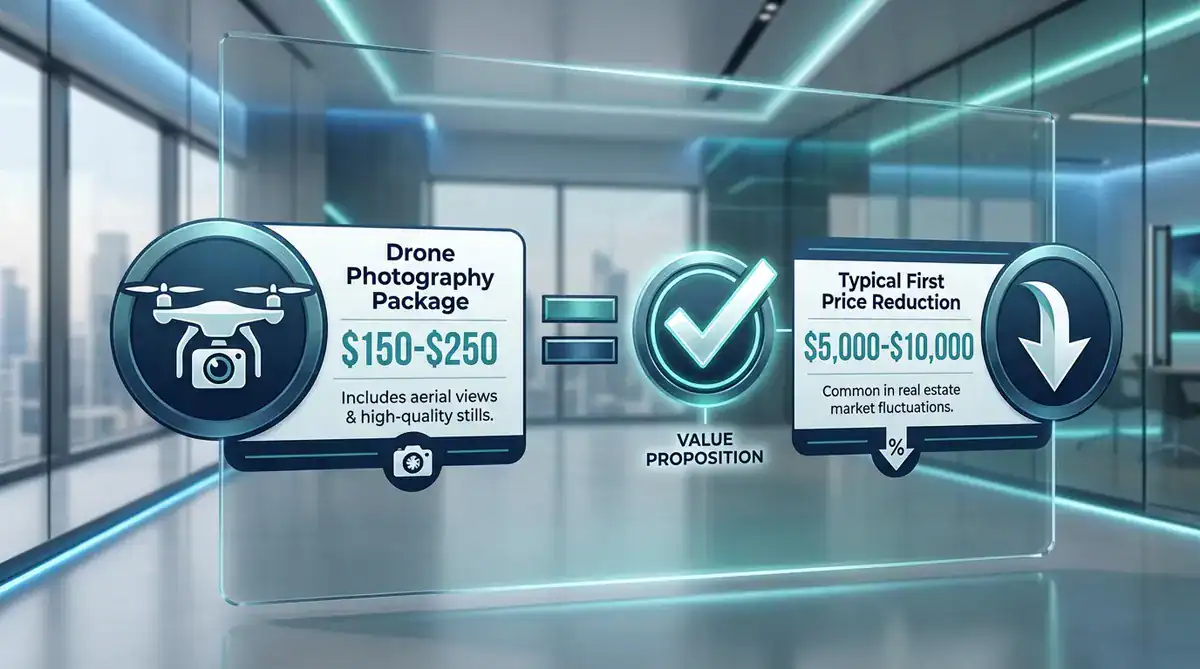
A standard aerial photo package runs $150-$250 in most markets. That gets you 10-15 high-resolution images from a licensed pilot. Compare that to what happens when a listing sits: the average first price reduction is $5,000 minimum, often closer to $10,000.
I tell clients to think of it this way: you’re spending 0.05% of the listing price to potentially avoid a 2% price cut. The math is pretty straightforward.
That said, I don’t recommend drones for every sub-$500K listing. There are specific scenarios where they work and others where they’re a waste of money.
When Drone Photography Actually Makes Sense
Properties That Benefit Most
After working with dozens of listings at various price points, I’ve identified clear patterns for when aerial photography delivers value:
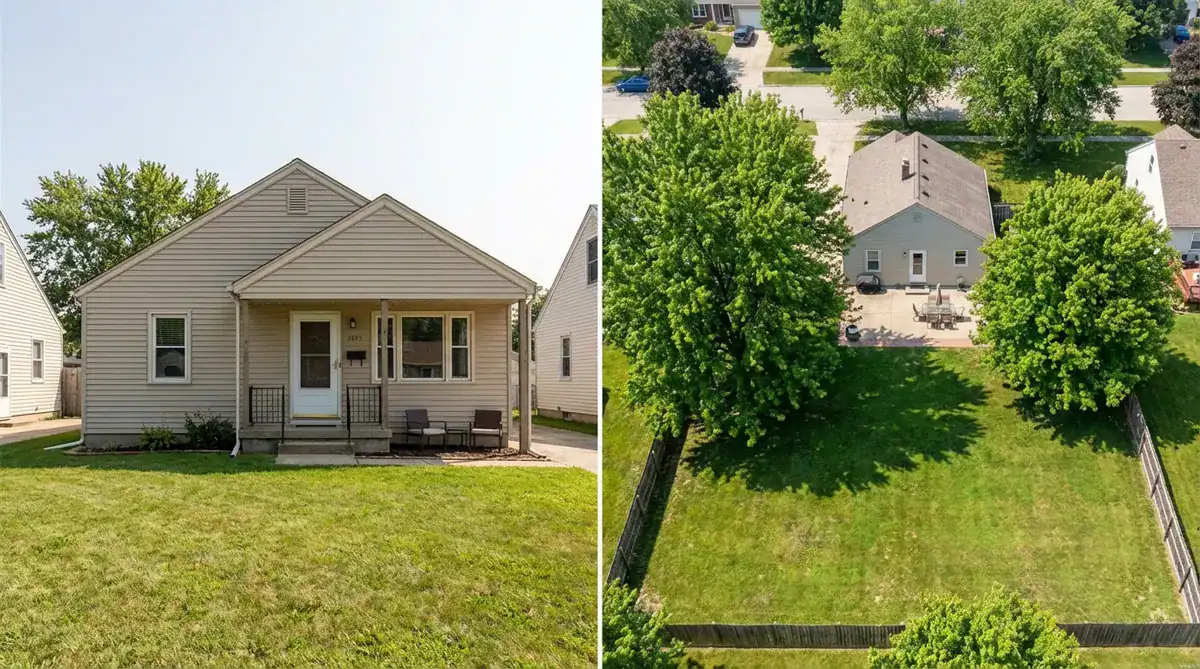
Large lots are the obvious winner. If a property has a half-acre or more, ground-level photos simply can’t capture the full scope. I worked with a $385,000 listing on 0.75 acres where the backyard included a detached workshop and mature fruit trees. From the street, it looked like every other house on the block. From 50 feet up? It looked like a small estate.
Waterfront or water views matter more than you’d think. Even a small creek, pond, or distant lake view adds perceived value. A client had a $440,000 home that was three blocks from a popular lake. The drone shot showing that proximity—along with a partial water view from the second floor—helped justify a $455,000 final sale price.
Recent exterior renovations deserve to be showcased. New roofs, solar panels, or complete landscaping overhauls look far more impressive from above. The investment is already made; the drone photos just help you capitalize on it.
Neighborhood context can be a selling point. If a home is within walking distance of good schools, parks, or shopping areas, aerial photos can visually demonstrate that proximity in ways that words can’t.
When to Save Your Money
I’ve also learned—sometimes expensively—when not to use drone photography.
Dense tree cover is the enemy. I once paid for a drone shoot only to realize the 100-year-old oaks completely obscured the house from above. The photos were useless. Now I always check Google Earth satellite view first. If you can’t see the roof clearly there, don’t bother with a drone.
Bad roof conditions are deal-breakers. Drone photography is honest—sometimes too honest. If the shingles are curling or the roof has visible damage, an aerial shot will make it the focal point of your listing. Fix the roof first, or stick with ground-level photos.
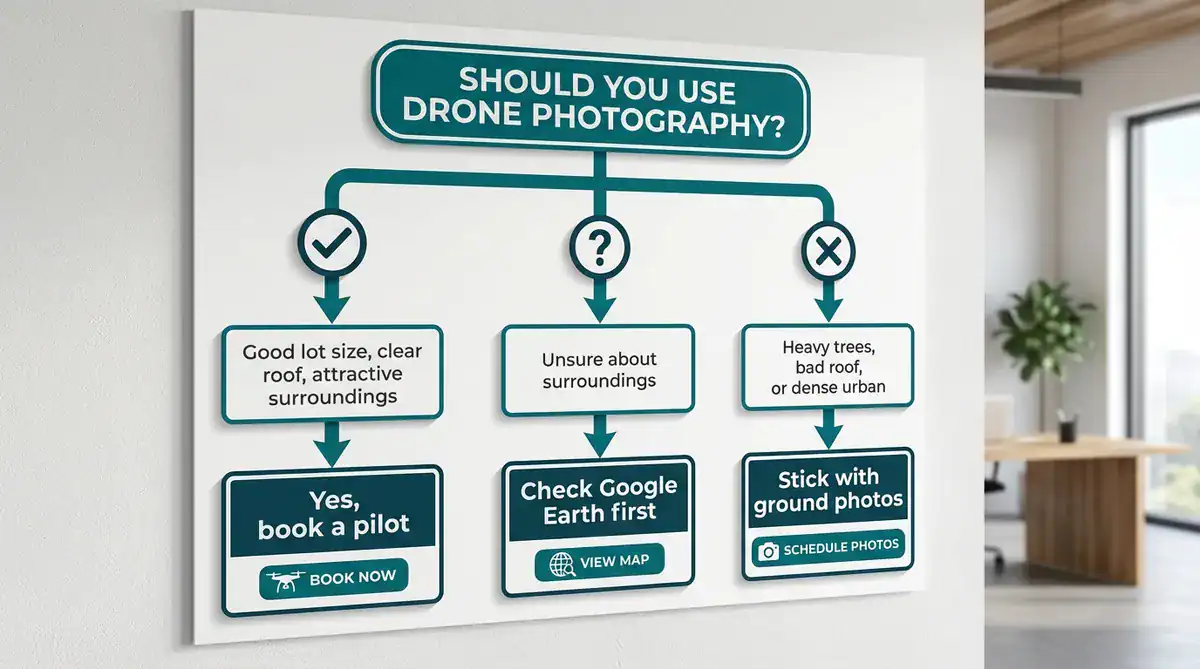
Unattractive surroundings can backfire. If a property backs onto a commercial area, sits next to a poorly maintained neighbor, or faces a busy highway, drone shots will emphasize these negatives. A client once insisted on aerials for a $365,000 home that was adjacent to a auto salvage yard. The photos were technically excellent, but they hurt more than helped.
Photos vs. Video: Where Should You Spend?
The Static Photo Advantage
For most listings under $500K, I recommend prioritizing still photography over video. Here’s why: the MLS and most property portals are still image-first platforms. Buyers scroll through photos before they ever consider watching a video.
A strong set of 10-12 aerial photos gives you flexibility. You can use different angles for different platforms, rotate through them if the listing sits for a while, and they’re easier for buyers to review at their own pace.
The cost difference matters too. Quality aerial photos run $150-$250. A professionally shot and edited drone video package? You’re looking at $400-$600. For a mid-range commission, that’s a significant chunk of your marketing budget.

When Video Makes Sense
That said, video has specific advantages—especially for social media marketing. I’ve found that short drone video clips (15-30 seconds) perform significantly better than photos on Instagram Reels and Facebook.
The trick is being strategic. If you’re planning to use a listing heavily in your social media strategy to generate seller leads, the video investment might be worth it. If you’re just trying to sell this one house efficiently, photos will do the job.
Some agents have started using AI Property Image to Video tools to create motion effects from static aerial photos. It’s not the same as native video, but it’s a middle ground that gives you animated content for social media without the full production cost.
The Psychology of Aerial Photography
How Buyers Actually Respond
There’s something about viewing a property from above that changes perception. I’ve watched this happen in real-time during showings. When buyers have seen strong aerial photos online, they arrive with a different mindset—they’ve already mentally elevated the property.
A colleague recently sold a fairly standard ranch home for $12,000 over asking. The winning buyers specifically mentioned in their offer letter that the aerial photos showing the property’s corner lot and mature landscaping made them feel like they were getting “more house” than the price suggested.
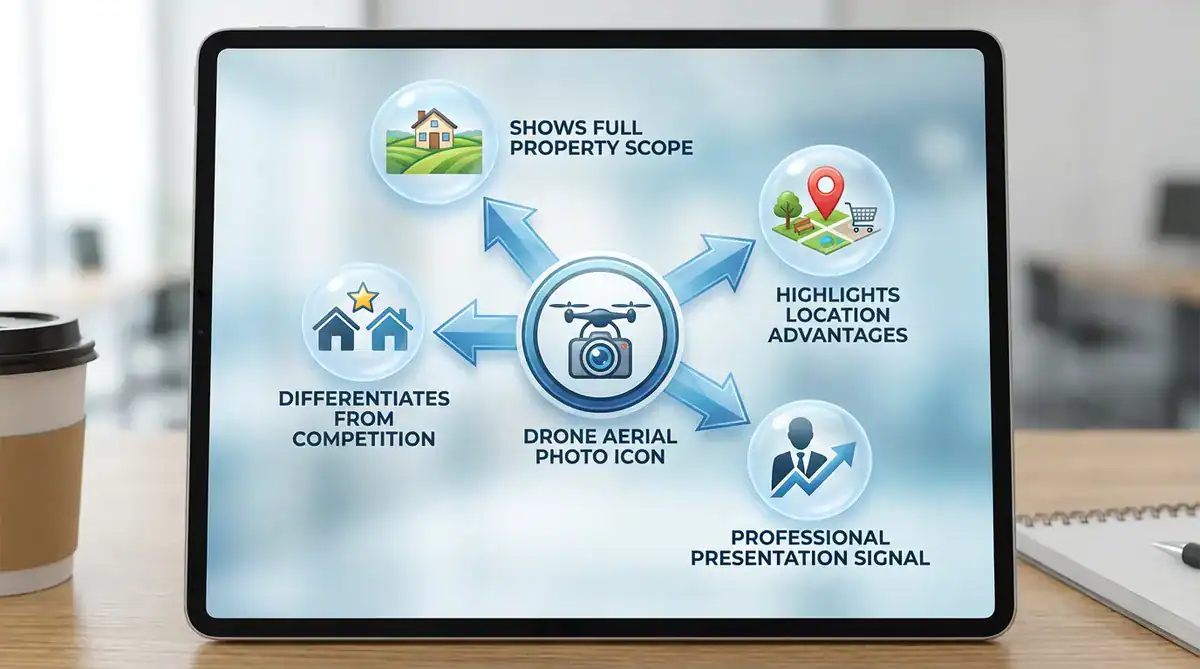
Research from various real estate photography studies suggests homes with professional photography—including aerials—can sell for 1-5% more than similar homes with amateur photos. On a $400,000 home, even 2% is $8,000. That’s real money.
But I want to be clear: the aerial photos themselves don’t add $8,000 to a home’s value. What they do is help you capture the actual value by preventing low-ball offers and attracting more serious buyers who can afford your asking price.
The Professional Signal
Beyond just showing the property, quality aerial photography sends a message about how the home is being marketed. It tells potential buyers that the seller (or their agent) is serious and professional.
I’ve noticed this particularly with out-of-town buyers. When someone is relocating and can’t easily visit multiple properties, the quality of the online listing becomes their primary decision-making tool. Comprehensive aerial photos often mean the difference between making someone’s shortlist or being scrolled past.
Practical Implementation Strategy
Getting Started with Drone Photography
If you’re convinced drone photography makes sense for your listing, here’s how to approach it effectively:
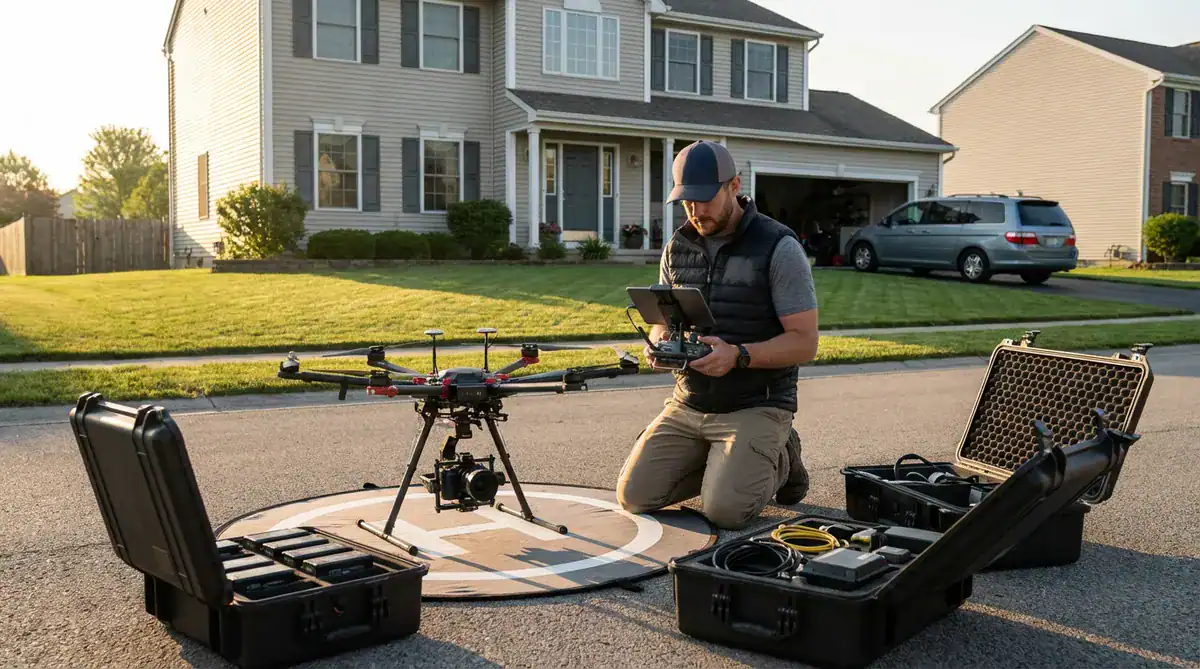
Find a licensed pilot. This is non-negotiable. In the US, commercial drone operators need FAA Part 107 certification. Beyond the legal requirement, licensed pilots understand composition, lighting, and how to capture properties effectively. The quality difference between a licensed professional and a hobbyist with a drone is substantial.
Schedule for optimal conditions. The best aerial photos happen during the “golden hour”—the first hour after sunrise or the last hour before sunset. Mid-day overhead sun creates harsh shadows and washed-out colors. Most good pilots won’t shoot in poor weather anyway, but timing matters for quality.
Communicate your priorities. Before the shoot, walk the property with your pilot if possible. Point out the features you want emphasized: the new deck, the lot size, the proximity to the park. A good pilot will plan their shots around your marketing strategy.
Making the Most of Your Investment
Once you have the photos, use them strategically:
The best aerial shot should be your primary listing photo on the MLS. This is your first impression—make it count. I typically see a 40-50% higher click-through rate when using an aerial as the lead image versus a standard front-exterior shot.
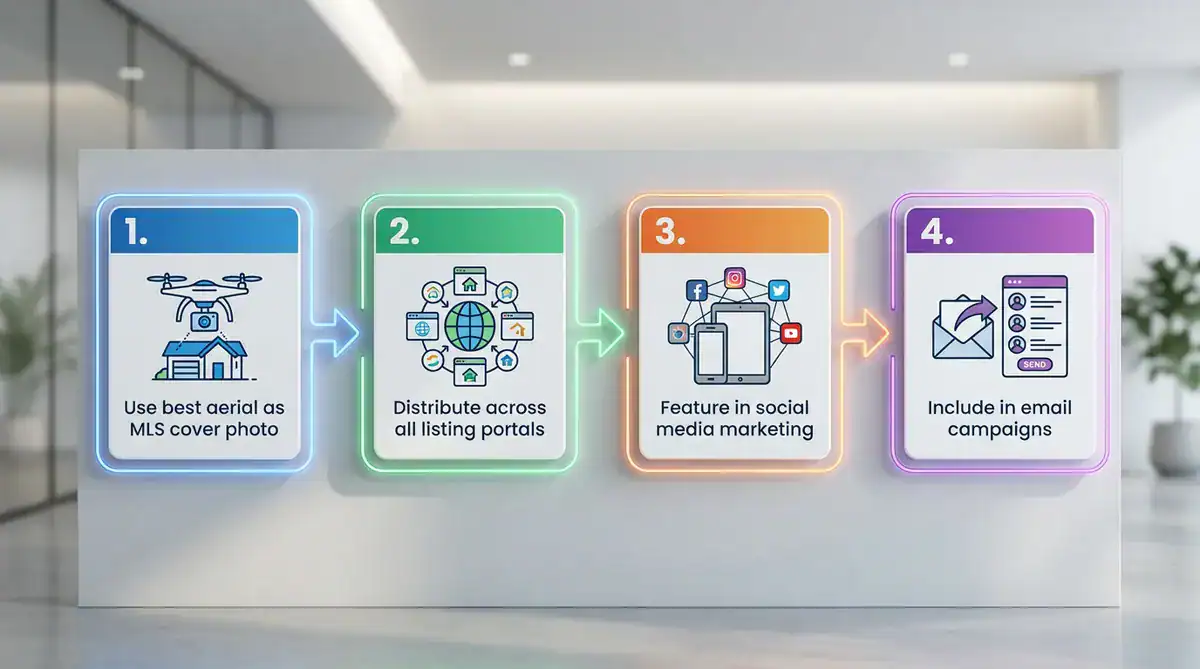
Don’t let these photos exist only in the MLS. Use them in your social media marketing, email newsletters to your sphere, and printed materials. If you’re creating a listing landing page, aerial photos make compelling hero images.
For properties with particularly strong aerial shots, consider creating a dedicated listing poster that features the best overhead view. These work well for open house signage and can help your listing stand out.
The Bottom Line
After years of testing different marketing approaches across various price points, I’ve come to view drone photography for sub-$500K properties as a strategic tool rather than a luxury add-on. It’s not appropriate for every listing, but when the conditions are right—good lot, clear skies, attractive surroundings—the investment typically pays for itself several times over.
The key is being honest about what aerial photography can and can’t do. It won’t fix a bad location or hide obvious property defects. What it will do is showcase legitimate advantages that ground-level photography simply can’t capture, help your listing stand out in a competitive market segment, and signal professionalism to potential buyers.
In a market where homes in the $300K-$500K range are often nearly identical from the street, that differentiation matters. The question isn’t whether you can afford to invest $150-$250 in aerial photography—it’s whether you can afford not to when your competition might be.
Frequently Asked Questions
How much should I expect to pay for real estate drone photography?
Standard packages typically run $150-$250 for 10-15 high-resolution photos. More comprehensive packages that include video or advanced editing can reach $400-$600. Prices vary by market—expect to pay more in major metros and less in rural areas.
Is drone photography worth it for a $300,000 home?
It depends entirely on the property characteristics. If the home has a large lot, attractive exterior features, or beneficial location context (near parks, schools, water), absolutely. If it’s a small lot in a dense neighborhood with no distinguishing features visible from above, probably not. Check the satellite view first.
Do I really need a licensed drone pilot?
Yes, for both legal and practical reasons. Commercial drone use requires FAA Part 107 certification in the US (similar regulations exist in other countries). Beyond legality, professional pilots understand composition, lighting, and property photography in ways that hobbyists typically don’t. The quality difference is noticeable.
Can aerial photos actually help a home sell faster?
Industry data consistently shows homes with aerial imagery sell faster than comparable listings without them—often 20-30% faster in the mid-range market. The mechanism is straightforward: better photos generate more clicks, more clicks lead to more showings, and more showings increase the likelihood of offers.
What’s the best time of day for drone photography?
Early morning or late afternoon during “golden hour” produces the best results. Avoid mid-day shooting when harsh overhead sun creates unflattering shadows and washed-out colors. Weather matters too—overcast days can work, but avoid shooting after rain when roofs and surfaces are wet and reflective.
