
How to Write Listing Descriptions That Actually Get Clicks (A Real Agent’s Guide)

Let me be honest with you: I wasted my first two years in real estate writing terrible listing descriptions. You know the type—”Welcome to your dream home!” followed by a wall of text that nobody read. My listings sat. My phone didn’t ring. It was frustrating.
Then I started paying attention to which listings actually got showings, and I realized something: the descriptions that performed well weren’t necessarily the most “creative.” They were strategic. They spoke directly to what buyers were actually searching for, and they made it easy to say “yes, I want to see this place.”
This guide is everything I wish someone had told me back then. No fluff, just what actually works.
Contents
- 1 Why Your Opening Line Matters More Than You Think
- 2 Understanding How Buyers Actually Search
- 3 The Problem-Solution Framework (This Changed My Career)
- 4 Writing for Humans AND Search Engines
- 5 Avoiding Legal Landmines
- 6 Making Your Description Scannable
- 7 Tools and Workflow
- 8 Quick Reference: Before You Publish
- 9 Final Thoughts
Why Your Opening Line Matters More Than You Think
The Three-Second Rule
Here’s what I learned from tracking my listing analytics: most buyers decide whether to keep reading in about three seconds. That’s it. If your first sentence is “Welcome to this charming home…” or “Don’t miss out on this opportunity,” you’ve already lost them.
I started testing different opening lines, and the results were dramatic. Compare these two:
Version A: “Welcome to this beautiful property that has so much to offer.”
Version B: “Renovated 3-bedroom Craftsman in Laurelhurst with south-facing garden and original hardwood floors.”
Version B got 3x more inquiries. Why? Because it immediately answers the buyer’s first three questions: What is it? Where is it? Why should I care?
Front-Load the Value
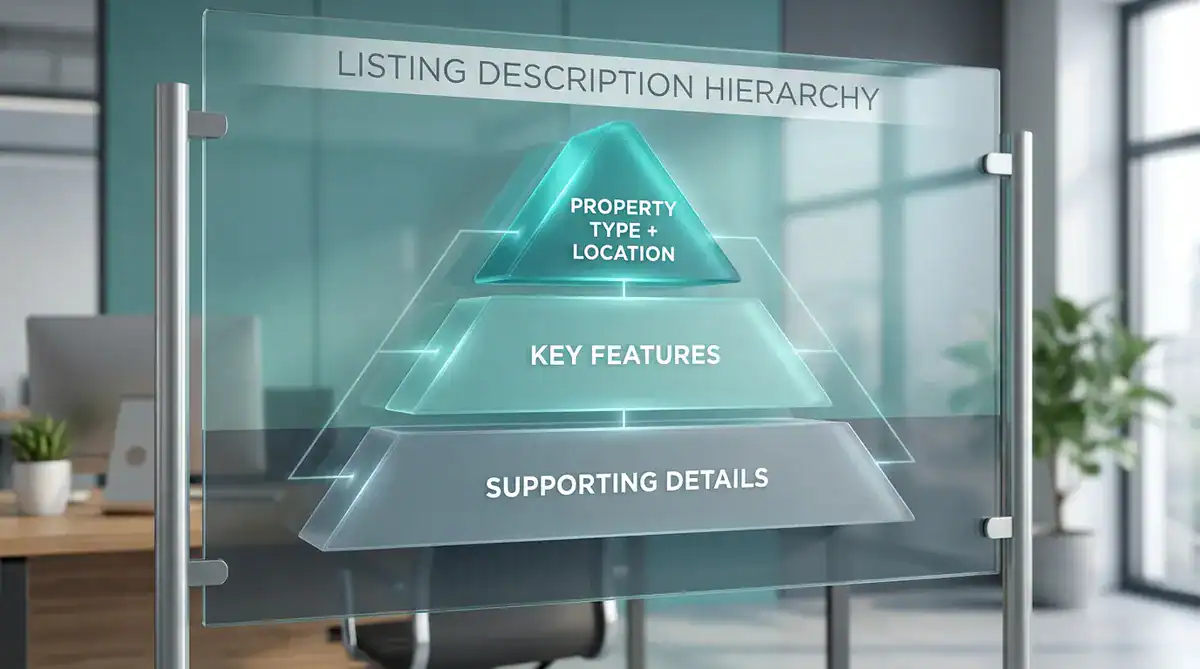
Think about how you search for things online. You don’t want to dig through paragraphs to find basic information. Neither do buyers. Your opening sentence should include:
- Property type and bedroom count
- Specific neighborhood (not just city)
- One standout feature that differentiates it
This isn’t about being robotic—it’s about respecting people’s time.
Understanding How Buyers Actually Search
Stop Writing for Other Agents
One of my mentors told me: “Write for the buyer, not for your broker.” That changed everything for me.
Most agents write MLS copy thinking other agents will read it. But in reality, 90% of buyers find properties online first, through search engines or listing portals. And they’re not searching for “motivated seller” or “priced to sell.”
What Buyers Type Into Google
I started keeping a list of actual search terms from my website analytics. Here’s what people really search for:
- “Home with fenced yard near [School Name]”
- “Condo with parking in [Neighborhood]”
- “House with home office [City]”
- “Townhouse with garage under 600k”
Notice the pattern? They’re specific. They include features, locations, and sometimes price ranges. Your description needs to mirror this language.
The Keyword Strategy That Works
Here’s my approach—no keyword stuffing, just natural integration:
Instead of: “This amazing home features stunning views.” Write: “Panoramic Elliott Bay views from the living room and primary bedroom.”
Instead of: “Great location.” Write: “Two blocks from Madison Park Beach and a five-minute walk to Madison Market.”
The specificity does two things: it helps search engines understand what you’re offering, and it helps buyers visualize whether this property fits their needs.
The Problem-Solution Framework (This Changed My Career)
Why Feature Lists Don’t Work

About three years into my career, I attended a copywriting workshop. The instructor said something that stuck with me: “People don’t buy features. They buy solutions to problems.”
I went back and rewrote all my active listings using this framework. Within two weeks, showing requests increased by 40%.
How to Identify the Problem
For every feature your property has, ask yourself: “What daily frustration does this solve?”
Let me show you what I mean:
Feature: Primary bedroom on main floor Problem it solves: Aging parents or anyone with mobility concerns avoiding stairs multiple times daily
How to write it: “Primary suite on the main floor means no stair climbing—whether you’re recovering from a knee surgery or just prefer single-level living.”
Feature: Oversized two-car garage Problem it solves: Lack of storage, need for workshop space, protection for vehicles
How to write it: “Finally, space for both cars plus room for bikes, tools, and seasonal gear—no more playing Tetris in a cramped garage.”
Real Examples From My Listings
Here are some before/after rewrites that significantly improved engagement:
Before: “Close to highway access.”
After: “Save 45 minutes daily with direct I-5 access—two minutes from your driveway to the on-ramp.”
Before: “Large kitchen.”
After: “Kitchen island seats six comfortably—perfect for homework help while you prep dinner or hosting friends for weekend brunch.”
Before: “Private backyard.”
After: “Fully fenced yard where kids and dogs can play safely while you relax on the deck with your coffee.”
See the difference? You’re not just describing the property—you’re describing the life they’ll live there.
Writing for Humans AND Search Engines
The Balance Nobody Talks About

This is where a lot of agents get stuck. They think SEO means writing awkward, keyword-heavy text that sounds like it was written by a robot. That’s not it at all.
Good SEO is about being specific and comprehensive. Let me break it down:
The Natural Integration Method
Neighborhood Context Don’t just say “Wallingford”—give context that includes natural keywords:
“Located in north Wallingford, half a block from the Burke-Gilman Trail and within the highly-rated Lincoln High School boundary. Walk to Molly Moon’s, Dick’s Drive-In, and QFC.”
This paragraph helps SEO (mentions neighborhood, school, trail, businesses) while also painting a picture for buyers.
Specific Upgrades Generic terms don’t help anyone. Be specific:
- Not “updated kitchen” → “White quartz countertops, soft-close cabinets, and stainless steel appliances installed in 2023”
- Not “new systems” → “New Lennox HVAC system (2024) and 50-gallon water heater (2023)”
- Not “modern features” → “Tesla charger in garage, Nest thermostat, and Cat-6 ethernet throughout”
These specifics serve double duty: they help your listing appear in targeted searches, and they answer questions buyers have before they even ask.
Avoiding Legal Landmines
Fair Housing Compliance (This Is Serious)
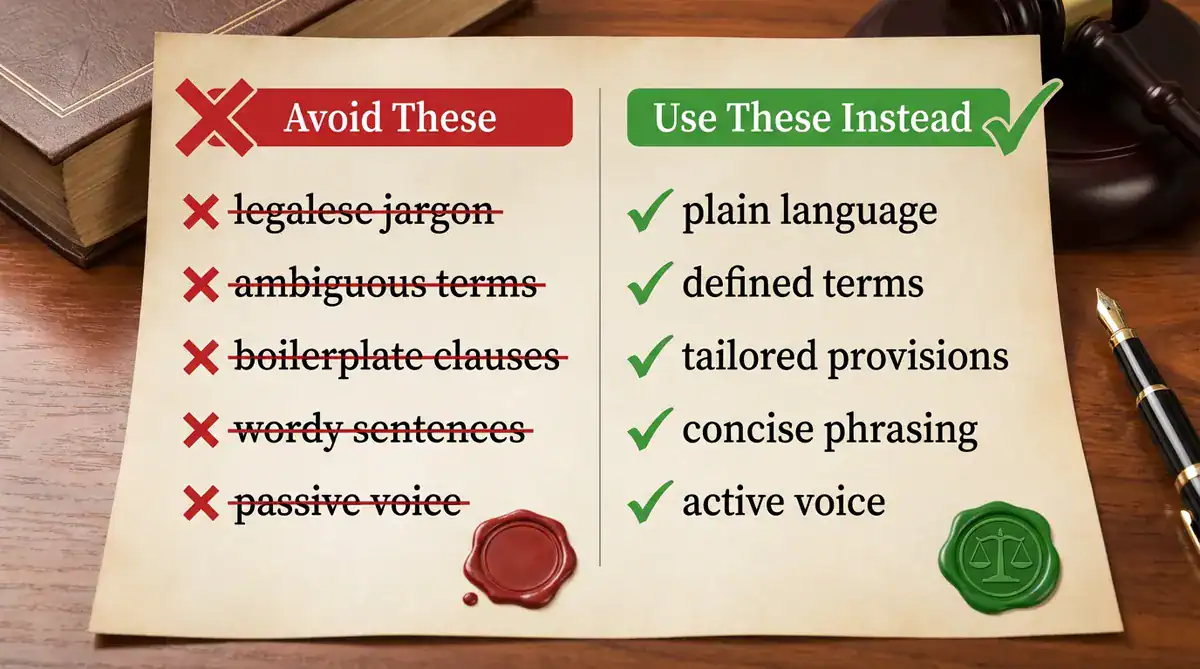
I’m going to be direct here: Fair Housing violations can end your career. I’ve seen it happen. You cannot, under any circumstances, describe who you think should buy the property.
Never write:
- “Perfect for families”
- “Great bachelor pad”
- “Ideal for empty nesters”
- “Young professional building”
Instead write:
- “Four bedrooms plus playroom”
- “Studio with efficient layout”
- “Single-level living with primary suite on main”
- “Building with co-working space and fitness center”
Describe the property and amenities—never the buyer.
Other Common Mistakes
All Caps Syndrome I see this constantly: “MUST SEE!!! AMAZING KITCHEN!!! WON’T LAST!!!”
It doesn’t help. It looks unprofessional and is actually harder to read. Use standard capitalization.
Vague Superlatives Terms like “hidden gem,” “one-of-a-kind,” or “too many features to list” are red flags. If it’s a gem, explain specifically why. If there are many features, list the top five.
Making Your Description Scannable
Short Paragraphs Are Your Friend
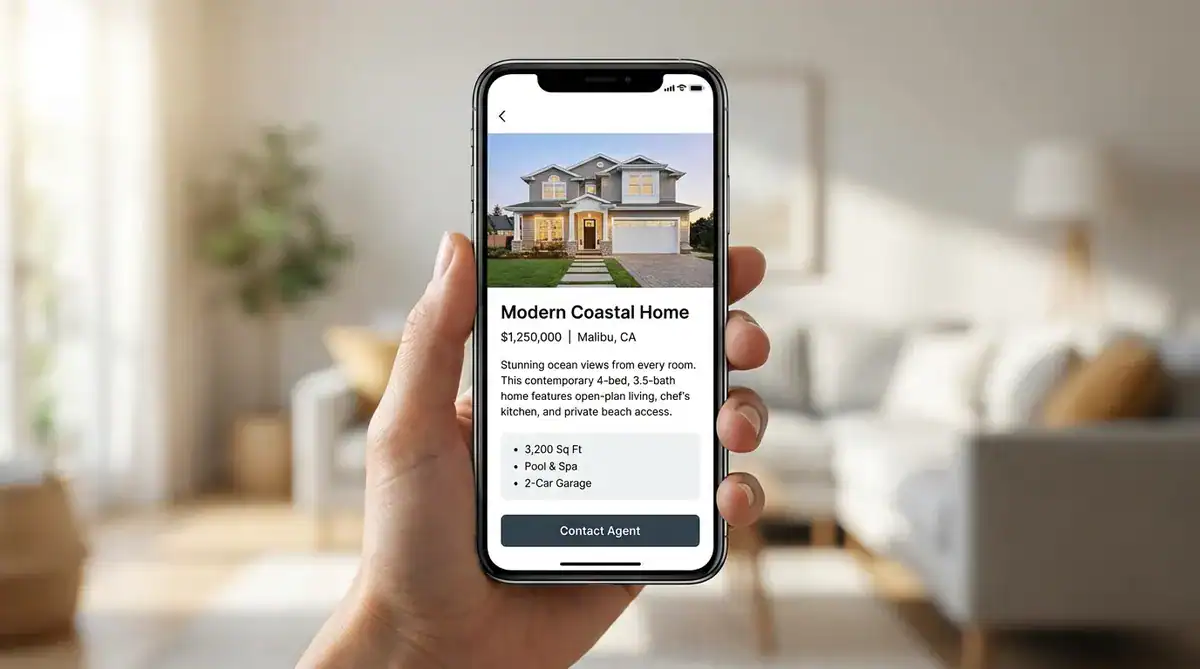
Most people read listings on their phones. Large blocks of text are intimidating on a small screen. I keep my paragraphs to 2-3 sentences maximum.
Here’s a structure that works:
Paragraph 1: Property type, location, standout feature (2 sentences)
Paragraph 2: Living spaces and flow (2-3 sentences)
Paragraph 3: Kitchen and dining (2 sentences)
Paragraph 4: Bedrooms and bathrooms (2-3 sentences)
Paragraph 5: Outdoor space (1-2 sentences)
Paragraph 6: Location/neighborhood benefits (2-3 sentences)
Paragraph 7: Practical details—parking, storage, recent updates (2 sentences)
Real Example
Let me show you a description I wrote that performed really well:
“Bright 2-bedroom condo in the heart of Capitol Hill with deeded parking and low HOA fees.
Step inside to 10-foot ceilings, exposed brick, and oversized windows that flood the space with natural light. The open floor plan flows from living to dining to kitchen—ideal for entertaining or just spreading out.
The kitchen features stainless appliances, deep drawers for storage, and granite counters with room for bar seating.
Both bedrooms fit queen beds comfortably, and the primary has two large closets. The updated bathroom includes a deep soaking tub and tile surround.
Private balcony overlooks quiet courtyard—perfect for morning coffee without street noise.
Walk to Cal Anderson Park, Pike-Pine restaurants, and Light Rail in under 10 minutes. Grocery stores, coffee shops, and nightlife all within blocks.
Secure entry, bike storage, one deeded parking space, and recent lobby renovation. HOA covers water, sewer, and garbage.”
Total word count: 152 words. Average time on listing page: 2 minutes 14 seconds. Showing requests: 17 in first week.
Tools and Workflow
Working Smarter, Not Harder
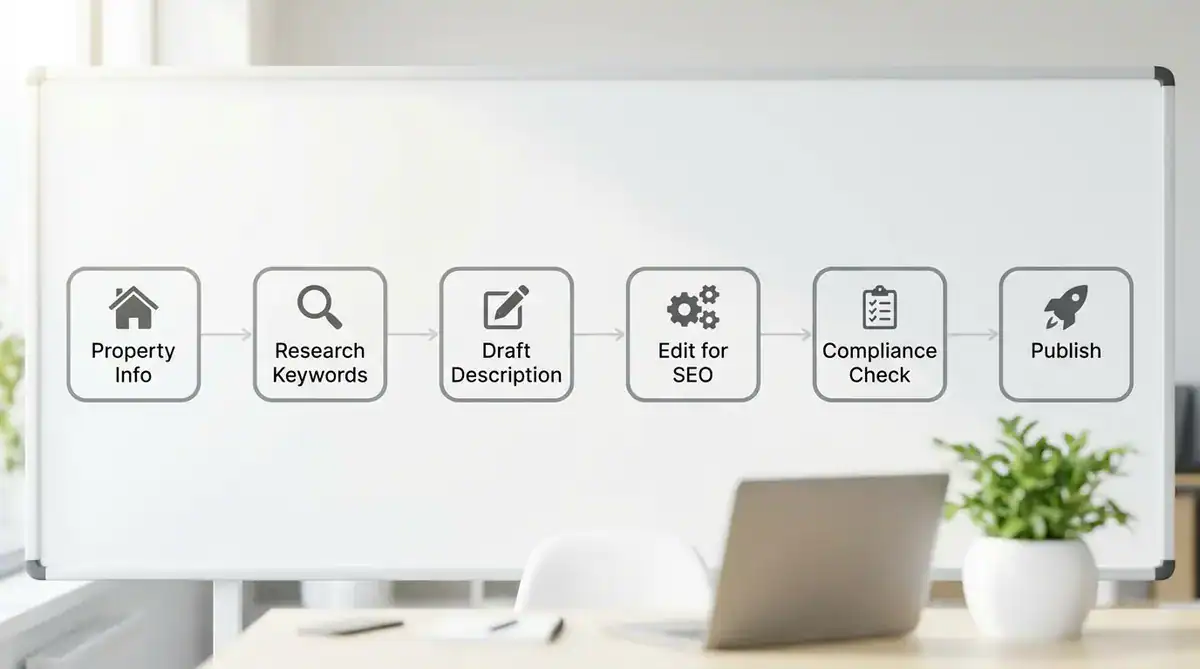
Writing unique, optimized descriptions for multiple listings every week is exhausting. I tried to do everything manually for years, and the quality definitely suffered by listing #3 or #4.
These days, I use a combination of tools to streamline the process:
- Google Keyword Planner: Free tool to see what terms people actually search for in my market
- Grammarly: Catches typos and awkward phrasing
- MLS analytics: Shows which of my descriptions get the most engagement
- Template system: I have frameworks for different property types that I customize
Some agents also use AI-assisted platforms to generate first drafts—these can be helpful for getting past blank-page syndrome, though you’ll always want to personalize and fact-check the output.
The goal is to maintain consistency across all your listings without burning out.
Quick Reference: Before You Publish
Here’s my personal checklist:
Content:
- Opening sentence includes property type, beds, and specific neighborhood
- At least 3 specific neighborhood references (schools, parks, businesses)
- Problems solved, not just features listed
- Actual upgrade details with years (not just “updated”)
- No Fair Housing violations
- No all-caps or excessive exclamation points
- Word count between 150-300 words
SEO:
- Specific terms instead of general adjectives
- Natural keyword integration (no stuffing)
- Long-tail phrases that match search behavior
- Proper spelling (no abbreviations like “w/d”)
Readability:
- Short paragraphs (2-3 sentences each)
- Scannability on mobile
- Sensory details for at least 2 spaces
- Proofread (read aloud to catch awkwardness)
Final Thoughts

Writing great listing descriptions isn’t about being a literary genius. It’s about being strategic, specific, and empathetic to what buyers actually need to know.
Start by auditing one of your current listings. Read the first sentence—does it immediately communicate value, or is it generic? Look at your feature descriptions—are they solving problems or just listing specs?
Make small changes first. Test different opening lines. Add neighborhood specifics. Reframe features as solutions. Track which changes improve your showing requests.
The listings that perform best are the ones where buyers can picture themselves living there before they even book the showing. That’s your goal: help them mentally move in through your words.
And remember—this skill compounds. Every description you write teaches you what works in your market. Six months from now, you’ll be writing these in half the time with better results.
Now go audit your listings. You’ve got this.
