
Win more listing presentations
Why Real Estate Video Matters in Washington, D.C.
Modern listing and marketing videos for Washington D C agents—without a full-time editor.
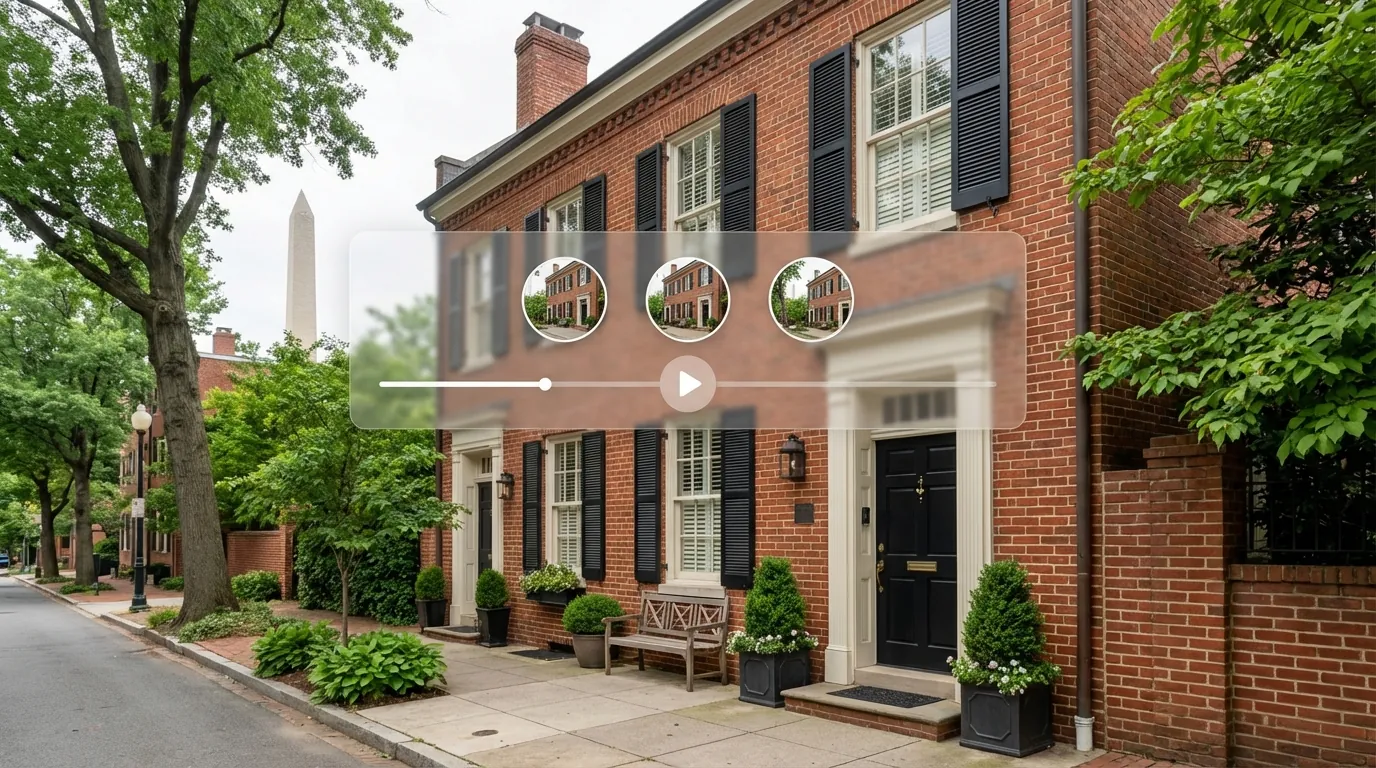
In Washington D C, first impressions are happening online long before an open house. Professional video makes your listings look premium from day one—and helps you stand out when buyers are comparing similar homes across neighborhoods and suburbs.
You get one core asset you can reuse on your listing page, in email, and in retargeting. Use our AI real estate video maker, pair it with local videography services, or run a hybrid—based on your listings, price points, and budget.
This isn\'t a "set-it-and-forget-it" market. In Washington D C, competitive pricing, fast-moving inventory, and buyer expectations mean your marketing has to work harder—especially on mobile and social.
With a mix of luxury high-rise condos, suburban new-build communities, and move-up single-family homes, you\'re competing with agents who invest in professional photography and promote listings heavily on video platforms.
Why Real Estate Video Matters in Washington, D.C.
Traditional videography for every listing can be expensive and hard to scale. That's why many Washington D C agents blend:
Mix and match solutions to fit your budget, listing type, and speed requirements.
• Keeps branding consistent across every listing (fonts, colors, captions, CTA).
• Great for teams: same style, different listings.
• Best for weekly posting and quick updates (open house, price improvement, new photos).
• Works well when your shot list is standardized.
• Make sure you have music/footage usage rights documented.
• Best when the property needs advanced lighting, sound, or specialized shots.
• Confirm turnaround time and revision policy up front.
• Build a reusable library: hooks, feature clips, neighborhood b‑roll, agent credibility snippets.
• Publish 3–5 pieces per week from one session.
• Shoot efficiently (or hire capture help) and use templates for consistent editing.
• Works well when attention is competitive and consistency wins.
Get professional videos ready for the Washington D C market in four simple steps.
Write your shot order on one note: exterior hook → main living flow → kitchen → primary suite → outdoor → CTA.
This prevents backtracking and makes editing faster.
• a vertical ‘hook’ clip you can reuse for ads
• one continuous walkthrough clip per main area (steady movement)
• 10 seconds of clean room tone for voiceover flexibility
• a quick outdoor/lifestyle clip (only what you can honestly show)
• 2–3 exterior establishing shots (keep them short)
Local note: Plan for traffic and street noise—prioritize interior audio and use text overlays to carry key details.
• Avoid ultra-wide distortion; keep lines straight.
• Keep captions on by default (silent autoplay is common).
• Add one CTA: DM, call, book a tour, or RSVP.
• Cut dead time aggressively (hallways, slow turns).
• Use one consistent intro/outro so your brand is recognizable.
Templates in Listinghub.ai help you keep this consistent across every listing.
• Export 9:16 for Reels/TikTok/Shorts, plus 16:9 for YouTube/FB.
• Reuse footage for open-house and price-update cuts.
• Post a short hook cut first, then the walkthrough cut later.
• Add a thumbnail/cover so the grid looks consistent.
• Track saves, shares, and inquiries—not just views.
Ads playbook →
ListingHub is designed to work for solo agents, teams, and brokerages in Washington D C. Start with a plan that covers your listings or scale up for high volume.
For most agents, the goal is consistency: a repeatable video process that runs every week.
Common questions about using ListingHub in the Washington D C market.